









The requirement for the October 2016 24-hour contest is "pasta":
https://boardgamegeek.com/thread/1648392/24-hour-contest-october-2016
Tips & Resources for Board Game Designers
The requirement for the October 2016 24-hour contest is "pasta":
https://boardgamegeek.com/thread/1648392/24-hour-contest-october-2016
18 Card Microgame Contest 2016
Deadline: Dec. 3, 2016
https://boardgamegeek.com/thread/1648402/18-card-microgame-contest-2016
In our Meaningful Decisions series, we ask designers about the design choices they made while creating their games, and what lessons other designers can take away from those decisions.
In this edition, we talk with Gil Hova, designer of The Networks, about incentivizing interesting behavior, elegance vs. fiddliness, solo modes and more.

You've said that one of your design philosophies is to "incentivize interesting behavior." What are some design choices you made in The Networks to incentivize interesting player behavior?
I think the biggest one was to make sure players stayed engaged in the core activity of the game, which is constantly canceling and developing TV shows. If a player stops doing that, the game gets dull.
Each show has a number of viewers that it gets over the course of four seasons. Generally, shows start strong, maybe get a little stronger or weaker in their second season, weaken in their third season, and are horrible in their fourth season. There are a couple of exceptions here and there (like the show "Broken Worse," which starts slow but peaks significantly in its third season), but every single show is terrible in its fourth season, and most are bad in their third season.
At the same time, there are three decks of Show cards that you use across the five seasons of the game. One is for Season 1, one is for Seasons 2-3, and one is for Seasons 4-5. Each deck is more powerful than the last, so Season 4-5 shows generally get more viewers than Season 2-3 shows.
These are both deliberate design decisions. At the start of each season, players will generally have one show in its third season, and a few shows available to develop that would be significant improvements. Some testers suggested a show that would get stronger in its fourth season, but that would do exactly the opposite of what I want. It would incentivize players to disengage from the core of the game, and that would make the game more boring.
Same thing with money being only a tiebreaker in the game. For a long time, I had a conversion of money to viewers at the end of the game, and then a bonus for most money. I found that was incentivizing hoarding, which is boring in this game. The Networks is fun when you're spending money, not when you're saving it. So there are no significant in-game rewards to have lots of money on hand, except for a couple of Network Cards and the 5-Show Genre Bonus (which you really need to work towards).
What can designers do to identify the interesting behavior that their game could bring out? Is this the same as the maxim that designers need to "find the fun" in their game?
Yes, I think that's generally the same thing, unless you're making a transformative/experiential game that is engineered to highlight disturbing or uncomfortable behavior. In that case, you're incentivizing something that isn't necessarily fun, but that should be rewarding if the design does what it should.
The biggest thing a designer can do here is playtest. Theorycrafting doesn't really get you very far. I recently worked on a small commissioned design, and I got it on the table as soon as I had a protean ruleset. I built the game around one aspect of the art of the cards, but I found that there was only one rule about passing cards that players were really having fun interacting with.
So I threw out all the art-related rules I had and rebuilt the game around passing cards. It was much better, and it only took me a few playtests to discover it. I would have never discovered it theorycrafting.
Related to this is: Don't be precious about your idea. Ideas are cheap. If I'd been precious about my art-based idea, I never would have been able to let go and pivot to the passing-cards idea. Let your initial idea be your scaffolding, and don't hesitate to dismantle that scaffolding once you find the soul of your game. You owe your original idea nothing.
If you're not used to this way of working, it can be very uncomfortable at first. There's a lot of blunt honesty, especially when you find a group of good playtesters, instead of the close friends and family that think the way to support you is to praise what you do, regardless of how they felt about it.
But if you're going to be a designer in this industry, blunt playtest feedback is just the beginning! You have all other sorts of great stuff to look forward to, like publisher rejections, failed Kickstarter projects, negative reviews, public criticism of your game (which is preferable to public indifference to your game), convention-goers rudely walking away from you as you start your demo, 1 ratings on BGG, and at least one GeekList notification of your game for trade, sale, or auction per day.
If you feel uncomfortable with any of the above, I would advise against designing games for anyone past your immediate circle of friends.
Sorry, I drifted a bit, but that's an important topic.
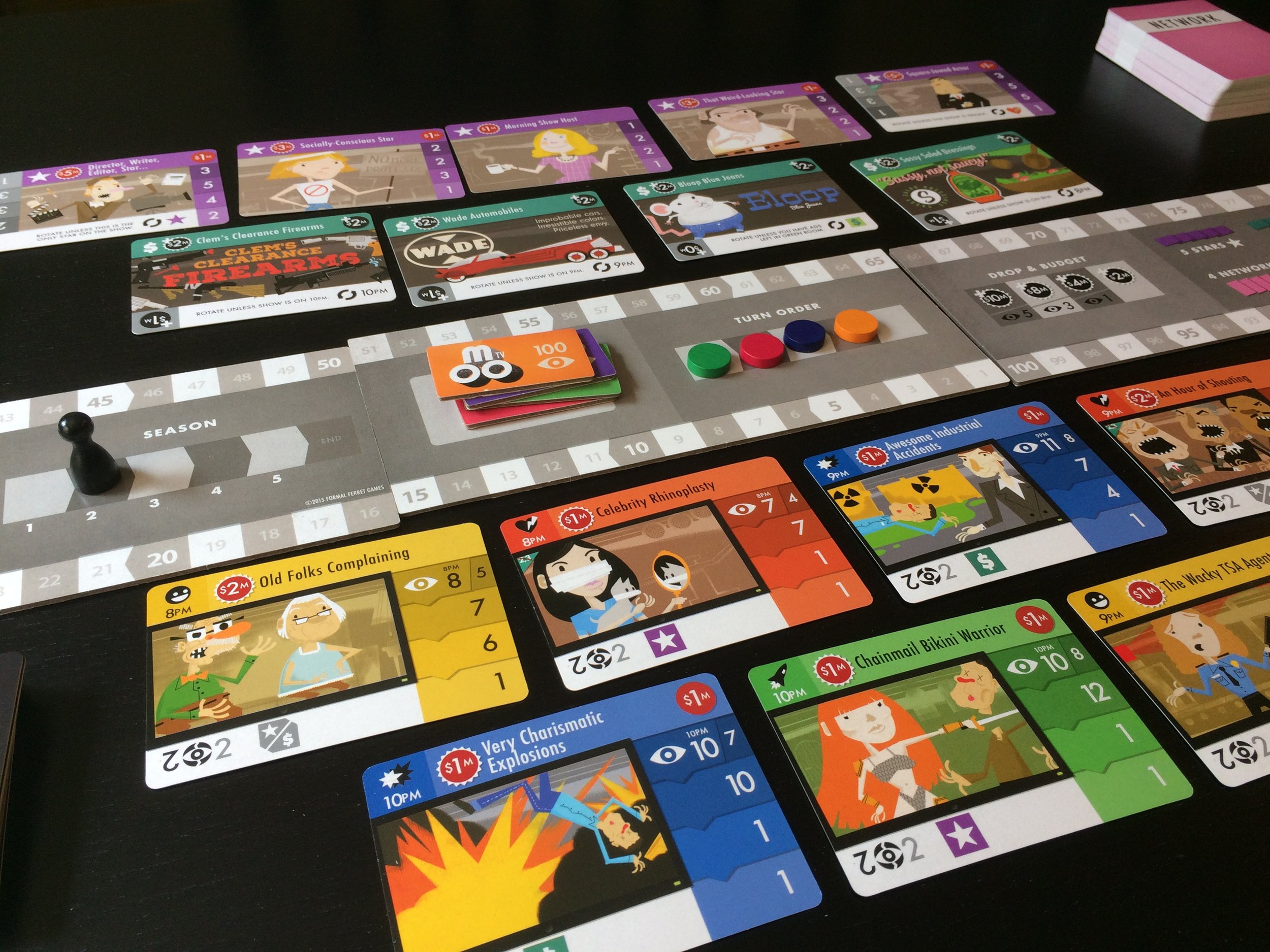
Each round, players score viewers and then age their shows. Why do players score their shows a second time at the end of the final season, instead of once as they do for every other season?
That's an important mechanism in the game. Without it, Season 5 would be short and anticlimactic. A show you get in Season 3 would be in its third season, so you may not feel the need to replace it. Also, Season 5 shows only score their first seasons, so they never get a chance to blossom if their second seasons are more powerful.
With the extra scoring, Season 3 shows will crash in final scoring, so players will need to replace those shows too. The end of the game becomes more urgent, critical, and dramatic. And Season 5 shows don't feel cheap.
When should designers create exceptions that sacrifice some consistency and elegance for a better play experience?
This is a very tough line to walk, and there's no consistent answer. One piece of writing that influenced me as a designer was Kory Heath's design blog for Zendo (which is still a fantastic read, and worth it for anyone interested in game design). Kory is almost religiously elegant in his game. He sweats and bleeds to make sure his games have no exceptions or weird edge cases. It's a fascinating mindset, and when I've tested with his friends, they are always pushing to streamline, streamline, streamline.
On the other hand, you have great games like Terra Mystica, Power Grid, and Brass, which almost flaunt their exceptions and edge cases. Remember when someone first tried to explain how the Bowls of Power work? How many times have you forgotten to discard the cheapest power plant in the market entering Phase 2? Don't even get me started on the freaking Birkenhead virtual link.
Obviously, there's a very big difference in weight, complexity, and play time between Brass and Zendo. So the bigger your game, the more tolerance it will have for exceptions and edge cases.
It's impossible to quantify this relationship. It's one of the many reasons why I'm such a big advocate of getting games on the table and testing them. Watch your players dealing with your game's edge cases. See if they enhance the fun of the game, or immediately attenuate it. If players keep intuitively thinking that a rule doesn't exist, it's a good sign that the rule shouldn't exist, and you had better find another way around the issue it's supposed to address.
This is also a good time to bring out another design maxim: Try to mix up your playtest groups. Don't test exclusively with a single group. After a few plays, your group will adapt to your game's fiddliness, but it's worth watching how another group tries to deal with it. If a bunch of groups have a hard time adapting to your game's complexity, and they're players you're specifically trying to target, then your game should probably be streamlined.
This is a question that fascinates me, though. I would love to design a deep, meaty, three-hour mega-Euro. But I have a tendency to streamline my designs, and they usually clock in at 90-120 minutes. I see other designers getting away with fiddly rules that my playtest groups and I would deep-six immediately.
The root cause is that those heavier games get their heaviness not from one or two complex systems interacting, but many simple systems interacting. New designers usually try to make games with many complex interlocking systems, which tend to be too opaque for players to be able to strategize through. But a good heavy game gets its heaviness from a few simple systems whose chaotic interactions open up all kinds of scenarios. This sort of chaos tends towards exceptions and edge cases.
If you take away one of those simple systems, you'll take away a lot of the exceptions and edge cases, but you'll also take away a lot of the game's meat. Think of Brass. Fundamentally, it's pretty simple; it's a few interlocking systems (coal/iron, cotton/ports, ships, canals/rails, cards, money/turn order) that are all easily explained on their own. But the way they interlock makes the game. If you removed half of those mechanisms, say, coal/iron and canals/rails, you'll have a simpler game, but one that's missing a lot of the meat that fans of the game were attracted to in the first place.
Splotter games are the same way. Food Chain Magnate, Great Zimbabwe, and Roads & Boats are all surprisingly elegant games, but they take some time to teach, learn, and play because of the complex interactions between all their systems. For all their complexity, they're surprisingly streamlined, and any further reduction in complexity would remove the souls from the games.
This might make a nice game design exercise. Find a 2+ hour game and try to shave an hour off its play time by removing at least one mechanism, while still making it engaging and interesting (albeit with a different level of engagement, as it will be a lighter game once you're through). It's amazing how much more bland the game will end up being; eliminating 25% of the rules could remove 75% of the fun!
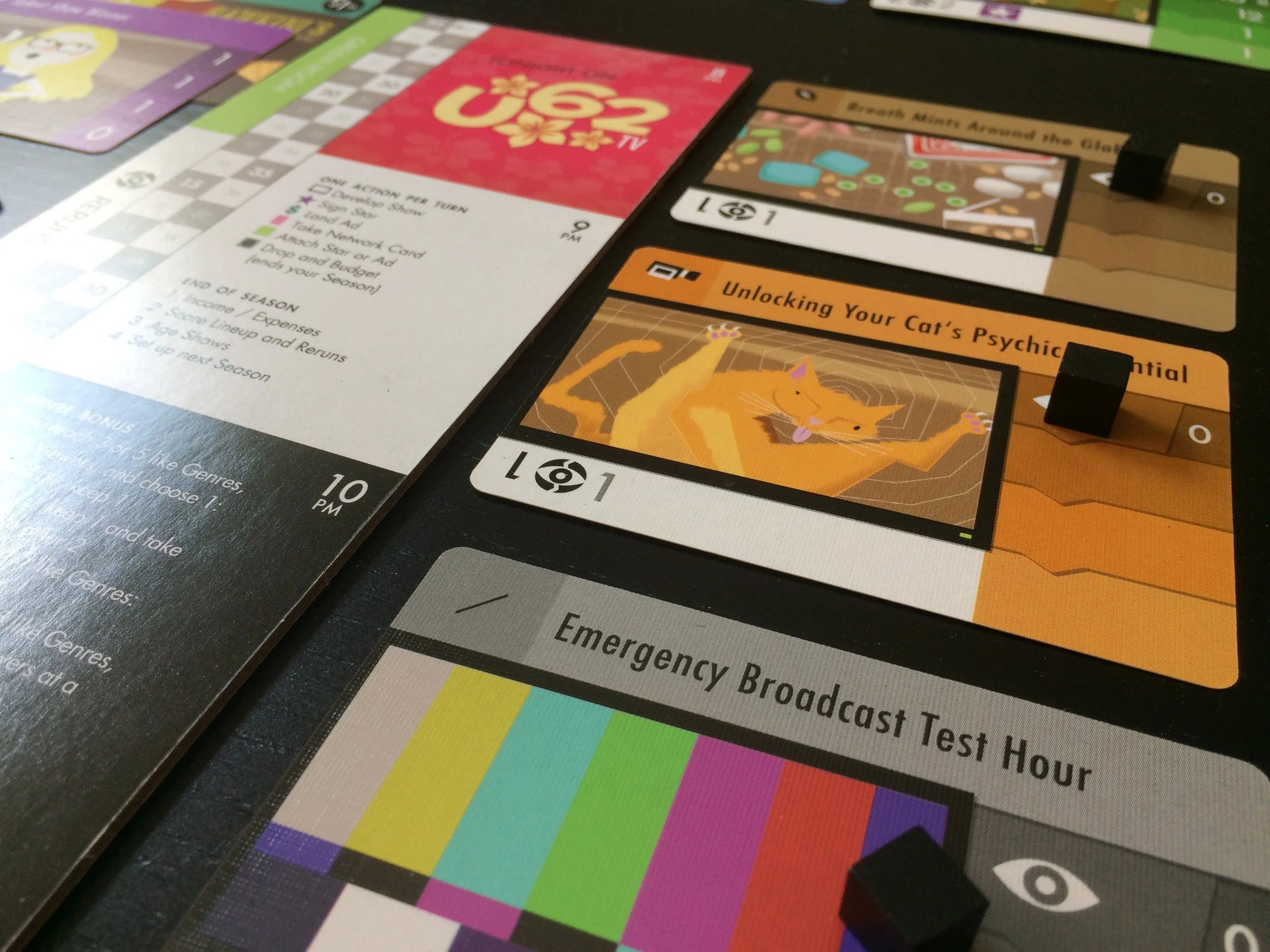
The Networks' solo mode adds an immediate loss condition, in addition to the win/loss endgame goal. Why?
Jane McGonigal points out that all games have goals and feedback. You take actions to advance to the goal, and the game gives you immediate feedback letting you know how much progress you made. This is a truth that all good games share.
I found the opening of the solo game was rather boring. You have a goal of 265 Viewers, but the game has a slow ramp-up. So let's say you have 50 viewers at the end of the second season. Is that good? Bad? There wasn't any feedback there at first, so I had to do a couple of things.
First, there's the immediate loss condition. So even before the 265 viewers, there's the question of if the solo player will even make it to the end of the game. Tension and stakes are present from the very beginning, especially if the player makes a risky move in the first season. The game is giving feedback on the immediate-loss axis, so there's significant meaning to early play.
Second, there are bonuses to hitting score targets in the second and fourth seasons. This helps offset early risk-taking. More importantly, it provides the critical long-term feedback the game was missing. Now, having 50 viewers at the end of the second season shows that you're 15 viewers short of the bonus that removes those nasty cubes from the board. Even though it's only Season 2 in a slowly-ramping game, we know we must take risks to hit 265 viewers and win the game.
What can designers do to add tension to a solo mode, in the absence of tension from the other players?
An immediate loss condition is one good thing. It focuses early play and makes early decisions meaningful. In my first game, Prolix, you're trying to hit a steadily-rising point target. If you miss, you're out.
My newer version of the game, Wordsy, has a slightly different solo mode. There's no immediate-loss condition, but there is a penalty if you don't hit a point target within a few consecutive rounds. That felt right for the game, as it plays so quickly, an immediate loss didn't really feel very significant.
Another good thing to do is to make sure early plays have clear and meaningful implications later in the game. I helped test the solo version of Cobras. Early on, you got one King Cobra card at the start of each of the three hands. I suggested getting two King Cobra cards at the start of the first hand, and being able to win a single King Cobra card by hitting a point target and the end of each hand. This way, the decision to hold or save a King Cobra card in the first and second hands is incredibly meaningful, as it's not guaranteed you'll have one in the final hand. You may even gamble and play two King Cobras in a single hand, if you feel confident you won't need one next hand. Instead of having each hand be an isolated atom, your play in one hand will have an impact in the next hand.
One thing about solo play and me: I don't like point grades at the end of the game. I don't want to know if I did "great" versus "good." To me, a binary outcome is more interesting: did I win or lose? I'm OK with a "critical win" or a "critical loss" to differentiate outcomes, or deciding on a higher point threshold when beginning the game to make the game scale better for experienced/inexperienced players, but if I finish a solo game just to see that I did "average," I'm not going to find that as satisfying.
Cardboard Edison is supported by our patrons on Patreon.
ADVISERS: Peter C. Hayward, RetroIn Games, Aaron Vanderbeek
SENIOR INVENTORS: Steven Cole, John du Bois, Richard Durham, Koen Hendrix, Chris and Kathy Keane (The Drs. Keane), Matthew O’Malley, Marcel Perro
JUNIOR INVENTORS: Ryan Abrams, Luis Lara, Behrooz Shahriari, Aidan Short, Jay Treat
ASSOCIATES: Robert Booth, Danica E., Doug Levandowski, Aaron Lim, Nathan Miller, Isaias Vallejo, Matt Wolfe
APPRENTICES: Kiva Fecteau, Scott Gottreu, JR Honeycutt, Knight Works, Scott Martel Jr., Mike Mullins, Marcus Ross, Sean Rumble, Diane Sauer, Smarter Backer
A step-by-step guide to setting your Kickstarter campaign's core pledge level:
http://stonemaiergames.com/kickstarter-lesson-201-a-step-by-step-guide-to-pricing-your-core-reward/
Situations you will face shipping a tabletop game project (audio):
October 2016 Game Design Showdown
Pitch a game inspired by a "classic" game
Deadline: Oct. 9, 2016
http://www.bgdf.com/forum/game-design/game-design-showdown/gds-october-2016-classic-spin
This month's roundup of our favorite board game design links includes an interview about a Spiel des Jahres nominee, thoughtful articles on small but important corners of game design, answers to legal questions and much more.
featured:
theory:
process:
“If you’re not prototyping your idea because you’re worried it won’t be fun enough, remember that games are more fun than game ideas.” - Jay Treat
licensing:
publishing:
industry:
Answers to game designers' legal questions: NDAs, IP protection, art contracts and lots more (audio). Part 1, Part 2.
“It’s way better to have a game that a smallish group really likes than a game that everyone kind of only sort of likes.” - Sandy Petersen
Cardboard Edison is supported by our patrons on Patreon.
ADVISERS: Peter C. Hayward, RetroIn Games, Aaron Vanderbeek
SENIOR INVENTORS: Steven Cole, John du Bois, Richard Durham, Koen Hendrix, Chris and Kathy Keane (The Drs. Keane), Marcel Perro, Behrooz Shahriari
JUNIOR INVENTORS: Ryan Abrams, Joshua Buergel, Luis Lara, Aidan Short, Jay Treat
ASSOCIATES: Robert Booth, Danica E., Doug Levandowski, Aaron Lim, Nathan Miller, Isaias Vallejo, Matt Wolfe
APPRENTICES: Kiva Fecteau, Scott Gottreu, JR Honeycutt, Knight Works, Scott Martel Jr., Mike Mullins, Marcus Ross, Sean Rumble, Diane Sauer, Smarter Backer
A discussion of various game design topics: observing playtesters, anti-quarterbacking, emergence and more (audio):
http://thegamedesignroundtable.com/2016/09/28/152-professor-rob%e2%80%99s-mailbag/
Advice for frustrated board game designers:
“Designer tip. Life tip. If you get to a certain point and get stuck... Ask for help. No shame in it.”
Options for shipping your game from the manufacturer:
http://www.blog.maydaygames.com/publishers-ship-boat-china-board-game-publishers/
An analysis of the "pool builder" genre:
Tricks for hiding math in the components of games:
A wide-ranging discussion about board game design, touching on topics including watching playtesters, finding an audience and quitting a design (audio):
http://cardboardarchitects.libsyn.com/designer-interview-grant-rodiek
Topics of interest to new board game designers and publishers: forming a business, manufacturing options, awards and contests, licensing contract royalties and more (audio):
https://boardgame.business/2016/09/24/game-design-and-publishing-panel-at-gen-con-2016/
The Game Crafter Adventure Challenge
Deadline: Dec. 5, 2016
Prizes: store credit and more
Tips for co-designing (video)
Should you publish your own game design?
http://blog.nskn.net/should-you-publish-your-own-game-design/
In our Meaningful Decisions series, we ask designers about the design choices they made while creating their games, and what lessons other designers can take away from those decisions.
In this edition, we talk with Phil Walker-Harding, the designer of Imhotep, about designing for an audience, player control, adding variable elements and more.
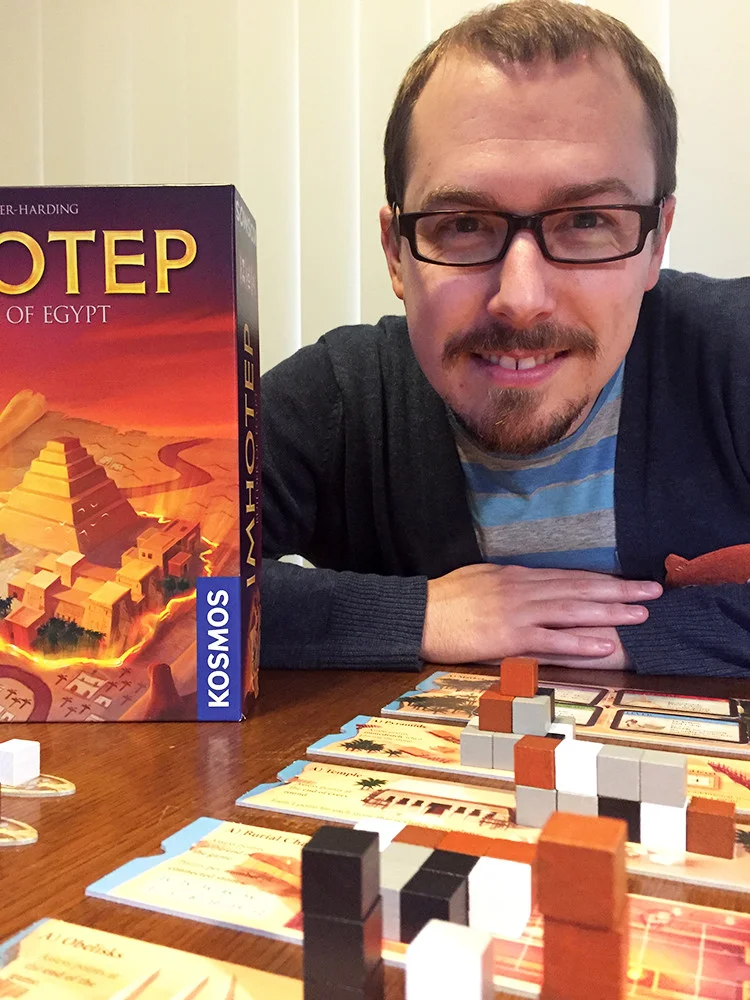
Certain players seem to be attracted to certain sites, each of which awards points or benefits in a different way. One rewards well-timed maneuvers, another is about edging out the competition, another is puzzle-y, and so on. How did you settle on the way the different sites behave? Was appealing to different types of players a conscious decision?
More than appealing to different types of players, I was really trying to make each site feel like a unique and interesting mini-game. So I suppose it makes sense that different players prefer the different styles of mini-games! In the very early stages of the design, the players were just building the pyramids, and straight points were awarded based on the position of each stone. But quite quickly I realised things would be much more interesting with multiple monuments that scored differently. Obelisks came to mind next, and it immediately made sense that they should score based on who had the tallest. The temple was inspired by Arkadia and Blokus 3D, where having your pieces be visible from above is important. I also wanted a site that used spatial connections, and this idea developed into the burial chamber. I have always been very influenced by Reiner Knizia's use of different methods (especially in Ra), and how they can drastically change the whole way you feel about some element of the game. So I am sure the lessons I have learnt from him were also at play as I designed the sites.
Are there ways a designer can make a game that "has something for everyone" by appealing to different types of players? Are there pitfalls to trying to do this?
I think it is really important that a designer has a specific audience in mind during the design process. I think the best way to be broadly appealing is actually to know your audience really well and then try and design a standout game for that audience. This way your game might jump out from the crowd and hopefully be found by other audiences who might enjoy the design. For example, when I designed Sushi Go! I was aiming at those who like quick cute colourful filler card games with just enough decision making to keep older players and even gamers a bit interested. Now that is quite a broad audience, but I did everything I could to hit that mark. I think if I had set out to include "something for everyone", for example some extra planning to appeal to advanced gamers, the design would have lost focus. It can be tempting to put disparate elements into a design in the hope of wide appeal, but I think it usually leads to more muddled designs that don't hit the spot for either audience.
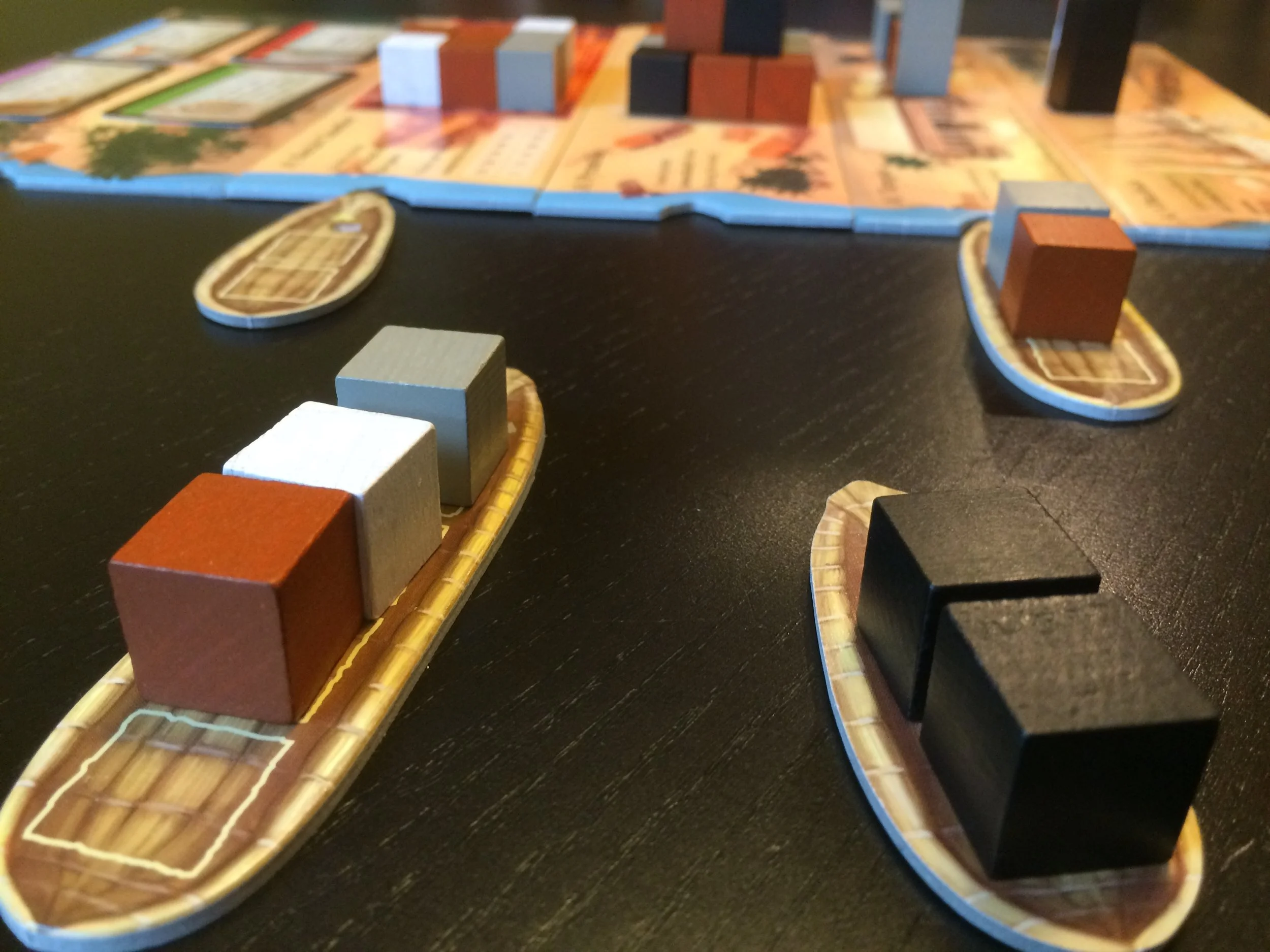
Players are allowed to sail a ship even if they don't have one of their stones on it. This means you rarely have total control over what happens to your stones. Was this always the case?
Yes, this was always the rule for sailing ships in Imhotep. I briefly tried some other rules but they were nowhere near as fun or interesting, and also presented other problems. For example, the timing and turn flow in Imhotep is very interesting to me and very important to the feel of the game. Every turn is a whole action and therefore crucial, so to place prerequisites on any of the actions (for example, you can't move a ship without any of your stones) would mean this structure would break down. An influence on this part of the game was the classic Coloretto. In that game you either add a card to a row or take a row of cards. When playing Coloretto I don't really think of the cards as mine until I have actually taken a row. Rather, I am focused on setting up each row to benefit me. So I suppose this was in my thinking as I designed the sailing mechanism. I was much more interested in the decision of how to best place your stones so that they are of some use, no matter where they are sailed. This also brings the players into all sorts of subtle conflicts and alliances and is really the core of the interaction within the game.
In general, how much control over their fate do players seem to be willing to cede to other players? Are there guidelines for designers to keep in mind?
This is of course pretty subjective, and there are many different tastes in game style. However, I do have a bit of a guideline for myself. I think it is very important that players have a strong sense of involvement in their own fate in a game. I am always trying to make sure the players' decisions feel important and respected by the game environment. For example, in Imhotep even if someone takes a ship somewhere I wouldn't prefer, I at least know that I chose to place my stone when and where I did, and that I left myself open for that ship to be moved. This is much more interesting to me than a straight "take that" mechanism--for example, where an opponent plays a hidden card on me that means I lose something. I had no involvement in that moment happening, and so it feels more like an attack or just bad luck. For me, the ideal in very interactive games is to make sure the players feel active in their destiny rather than like they are just being acted upon.
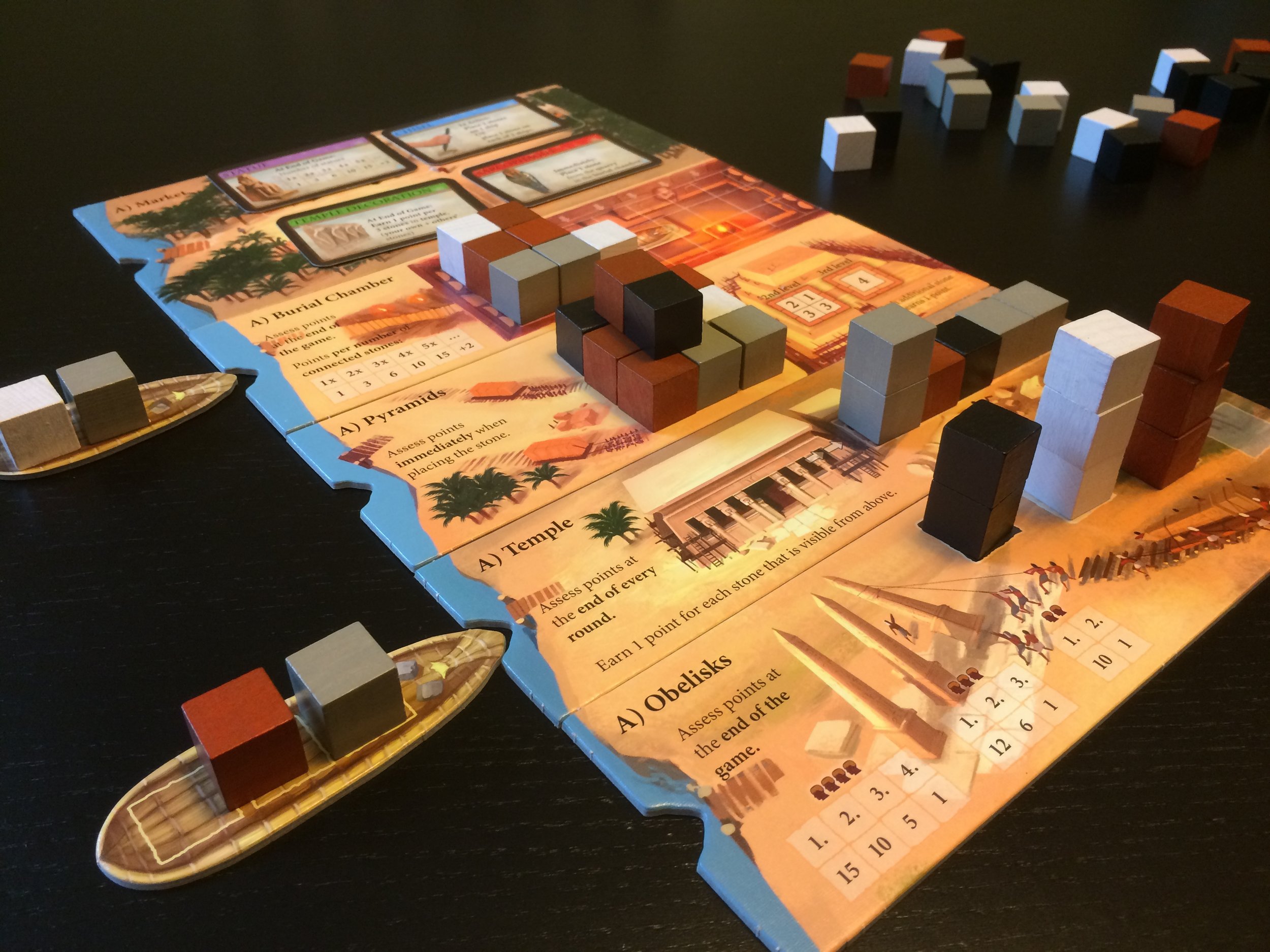
Imhotep comes with a second set of sites. How did you decide which sites to include on side A and which to include on side B?
The B sides were actually something which came along later in development in order to increase the game's replayability. I first thought it would be quite easy to find four new board designs, but it actually proved very tricky! The structure of the game was so tight that many ideas that I thought would work really didn't. So in the end there were only four new sites that both myself and the publisher felt were really keepers. The secondary versions of the palace and pyramids are more complex rules-wise so we put them on the B sides. The B side of the obelisks and burial chamber are quite similar in complexity, but I was so used to my original versions, and I slightly prefer them, so it felt right to keep them on the A sides. Since the game's release I have managed to come up with some more site designs, should an expansion ever happen!
Are there things designers should keep in mind when creating alternative mechanisms or scoring conditions for their game?
Adding variable elements to a game is a really interesting part of designing to me. Dominion is recognised for introducing the deck-building mechanism, but I think it has also been very influential in showing how fascinating it can be to have high variability in a game's setup. My advice when attempting this would be to first do a huge brainstorm of many different ideas. Think about all your favourite games and if there are any elements in them that could be adapted into the gameplay of your design. Then it is a matter of testing them all out and only persisting with those that really feel "within the spirit" of the original game. Having elements that seem different to players but not so different they don't belong can be a hard balance to find. I think the aim is to have each alternative seem like it naturally belongs in the game, rather than feeling strange or like a gimmick. Also, it should be said that not every game needs huge variability. Sometimes throwing extra ideas in just because you have them can confuse players learning the game or just dilute the way the game presents itself.
Cardboard Edison is supported by our patrons on Patreon.
ADVISERS: Peter C. Hayward, RetroIn Games, Aaron Vanderbeek
SENIOR INVENTORS: Steven Cole, John du Bois, Richard Durham, Koen Hendrix, Chris and Kathy Keane (The Drs. Keane), Matthew O’Malley, Marcel Perro
JUNIOR INVENTORS: Ryan Abrams, Luis Lara, Behrooz Shahriari, Aidan Short, Jay Treat
ASSOCIATES: Robert Booth, Danica E., Doug Levandowski, Aaron Lim, Nathan Miller, Isaias Vallejo, Matt Wolfe
APPRENTICES: Kevin Brusky, Kiva Fecteau, Scott Gottreu, JR Honeycutt, Knight Works, Scott Martel Jr., Mike Mullins, Marcus Ross, Sean Rumble, Diane Sauer, Smarter Backer