







Thinking about games in terms of player interaction and planning horizon:
How to get a board game into distribution:
https://boardgame.business/2016/05/21/how-to-get-into-distribution/
Converting a miniatures game into a board game and vice versa:
https://kevingnunn.com/2016/05/20/cross-platform-game-design-part-2/
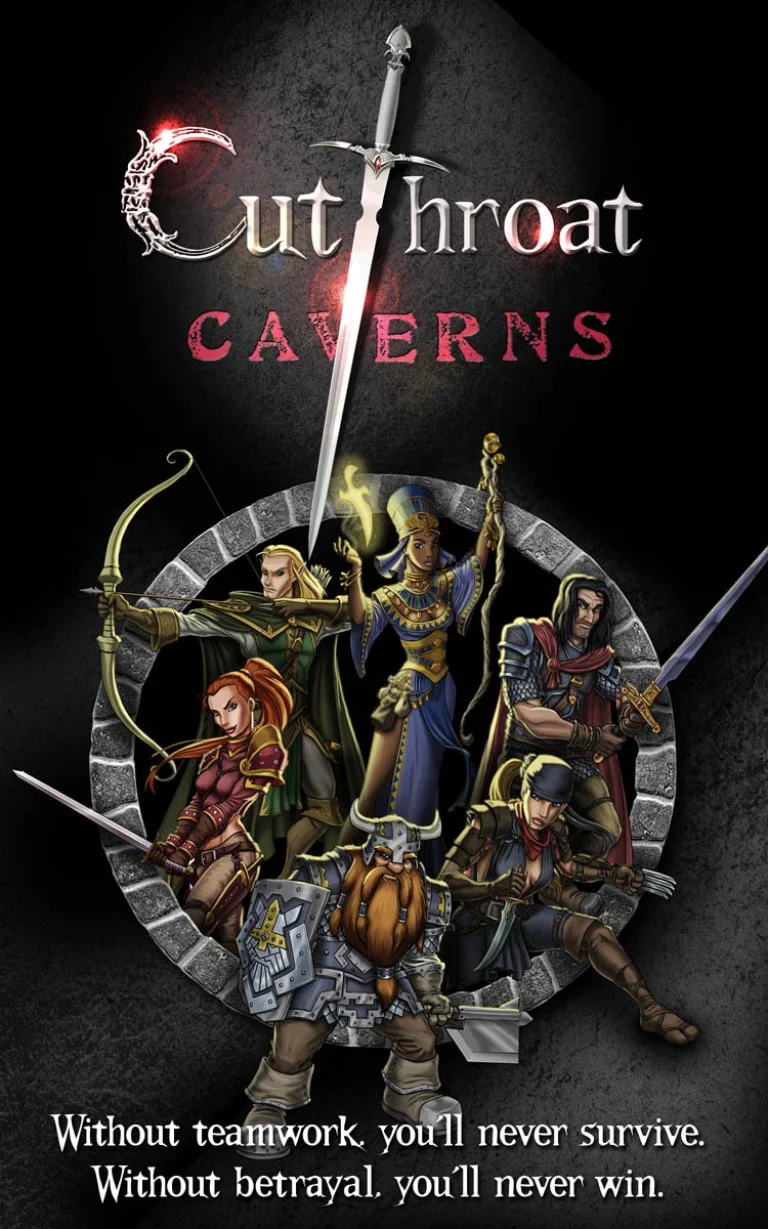
The Process: Cutthroat Caverns by Curt Covert
/In The Process, board game designers walk us through the process of creating their game from start to finish, and how following their path can help others along theirs.
In this installment, Curt Covert describes how he created Cutthroat Caverns, including how a new gaming group inspired the game, designing with your own sensibility, engaging players’ emotions, finding art on a budget pre-Kickstarter, marketing by word of mouth, the importance of customer service and more.
Theory
My company, Smirk & Dagger Games, is well-known for its design aesthetic, in that we specialize in “stab your buddy” games. I just think they are more fun--highly emotional, laugh-filled, curse-filled, fun.
Every aspect of Cutthroat Caverns was carefully designed to live up to that and was inspired by my early years of playing Dungeons & Dragons. You see, my high school D&D group was very Tolkien-esque. We were all pretty Lawful Good, “all for one, one for all” brothers in arms. (Actually, my 1980’s player group was entirely women, other than me, but that’s beside the point.) If you found a magical item, you gave it to the person who could best wield it. We were all true heroes.
Well, when I got to college and played the first time with a whole new group, it was quite different. Chaotic Evil alignments, selfish unscrupulous folk, assassins, true mercenary brutes, all of them. I shall never forget the horrifying moment that I suddenly realized that the other players in my party were far more dangerous than any creature the DM could summon. That feeling of shock and horror was the exactly what I wanted to recreate and perpetuate throughout Cutthroat Caverns.
So I started with the premise. You’re a group of adventurers who had vowed, by all you hold sacred, that each day the first pick of treasure would go to the person with the most prestigious kills--except today, you found “the one ring / the holy grail / the most glorious treasure imaginable” and now you will do anything to make sure that person is you. But this is a vicious dungeon, filled with creatures that will overwhelm and destroy you, and you must escape before you can claim your prize. As the box says, “Without Teamwork you’ll never survive. Without Betrayal, you’ll never win.” It is a game about “kill stealing” and gaining more prestige by landing more killing blows on the toughest creatures--before the other party members can. It was a simple enough construct--but lead to a pretty unique style of game play. Too diabolical to be called a semi co-op, I coined the term “cooperative backstabbing.”
The monsters in the game had to be deadly and the illustrations and mood of the game had to put players on the defensive. Each time an Encounter is revealed, there has to be a gasp around the table--an ‘oh, crap!’ moment, in which they fear for their lives. That perpetual feeling becomes the driving force to work together. Then, balanced in equal measure, each creature also provides a reward for your sudden and inevitable betrayal.
It was clear that the creature stats would need to increase with the number of players at the table, in order to keep the threat level appropriate. But I took this opportunity to assure that the player elimination aspect of the game, which can be polarizing for players, didn’t lead to anyone being pushed out too soon. I simply ruled that, should players die early on, the creatures you’ve yet to face would not get weaker. The creature stats remain set to the number of people who started the game and the remaining players may no longer have enough firepower to win. This encourages keeping your opponents alive in the first three quarters of the game, yet allows for player elimination in the end game, especially of the prestige leaders, to remain an important avenue for players to win.
I then turned my focus to the players and the core mechanics of the game. For thematic reasons, I didn’t want any straight-up, player-versus-player combat. After all, we are a team--right, Boromir? Instead, player conflict would be more passive aggressive, as you attempt to get other players hit more often by the monsters. I also decided, at the outset, that there would be no dice rolling in the game, especially in regards to combat. Those games already existed and I was hunting for a different experience. But more important, I wanted players to have a high degree of control over how hard or soft they would strike. I wanted an intricate dance as they jockeyed for position to land the killing blow. Borrowing initiative order from my days of D&D, players would know and could plan their strategy in secret based on turn order, but would have to “set” their selected attack without knowing how hard others would swing.
I was delighted to discover that cards doing little or no damage could be just as valuable as those doing a lot of damage. If you can’t kill the creature yourself this turn, your best play is to sandbag, hoping the creature survives long enough for you to kill it next round. Most players assume low cards are worthless and watching their faces light up as they discover their value is almost as sweet as watching the faces of those who feel robbed of a kill, because they had planned on you doing more damage. I love to see people discard low cards, knowing they still have much to learn about the game.
Of course, there needed to be “take that” cards capable of increasing or decreasing your attack strength, changing initiative, spoiling your attack completely, stealing items or reassigning damage as well as limited-use items to fight over, which never get shuffled back into the deck, to keep their intrinsic value high.
There were two design decisions that were long debated, Bonus Prestige and Character Abilities. One concern, early in design, was the emergence of a “runaway leader.” At some point, it could be mathematically impossible to catch up with the leader, and this drains the fun out of the endgame. One solution is for players to eliminate the leader or several of them at the end of the game, but this is not always possible. So I devised a somewhat controversial fix, Bonus Prestige. In Rounds 7 and 8, as the exit draws closer and the tension rises, creatures deliver 3 additional bonus prestige. In rounds 9+, five bonus prestige are added. This provides those trailing in prestige a means to catch up in the critical last rounds. It is an effective solution, but has been criticized by some who felt the first encounters mean almost nothing, so long as you score the final kill. In truth, it isn’t quite so, but it most certainly can make all the difference. But I could find no better solution at the time. Since then, additional prestige resources (Relics, for example) have mitigated this.
The second debated design consideration, perhaps the most hotly fought in development, was whether or not we should have asymmetrical characters in the game, granting players unique abilities. With the creatures changing the play environment every round, with different rules and exceptions, I felt strongly that player abilities would only further complicate the game. Worse, I was afraid that players would argue about the balance of the character abilities. I never wanted to hear, “If I’m not the Dwarf, I’m not playing. That’s the only way to win.” Instead, I wanted the sole focus of the game to be about the players themselves and what they were willing to do to each other to win. That was far more interesting and engaging game play, a social experiment almost. But my partner argued that when you play a fantasy adventure game, players want and expect that their characters will be unique. We were both 100% correct. I made the final call to go without. It was more important to deliver a game unique unto itself.
But fans echoed my partner’s position. In the first expansion, I tried a limited one-use ability to try and meet their demands, but I was never happy with it. Years later, with the concept of drafting more popular, I finally found a great solution. I allowed players to draft ability cards and then choose abilities they wanted before the game began. But for each they took, their maximum Life Totals would be decreased. The fact that they could construct their own characters removed the possibility of arguments over balance. In addition, we created 12 pre-set characters, should players want to play them, which were created from the ability cards used in the draft, theming the official characters of the game. I’ve been very pleased with how it came out.
In truth, the “tool kit” of mechanics and variables in Cutthroat Caverns are fairly limited and straightforward. And it is therefore shocking how much variety we have been able to deliver, in terms of unique encounters (of which there are now 140 or so), items and events. Each encounter drips with theme and plays very differently from one another. This variety, and the emotional impact the game delivers, is what brings people back, time and time again. I think it remains my best design.
The Takeaway: Create a glossary for your game at the outset, and live by it religiously. I’ve had a very rough learning curve on this with Cutthroat. Synonyms, alternate phrasings, inconsistent descriptions can all lead gamers to infer unique rules loopholes, where you intended none, or else lead to needless confusion. I’m sad to say, the game still suffers a bit from my sins of the past in this regard, but I’ve learned a valuable lesson for the future.
Without engaging the emotions during the game, there is no story to tell after the game. Epic betrayals, clutch plays, triumphant comes-from-behind--this is the stuff of legends. Playing your game should lead to great tales.
I love the delicate balance of cooperation and betrayal needed to win. There is such an amazing dynamic here and one I would love to see explored more in the industry.
The best designs allow your fans to contribute to the game. After our first expansion, I wanted to deepen the relationship with fans and their involvement in the game--just as I had done so many years ago building expanded content for games I loved. In Deeper & Darker, I included a surrogate encounter card that would be a placeholder in the deck for your own creature designs. A year later, I ran a contest to create a new encounter for the game. The winner would have their encounter considered for inclusion in our next expansion and they’d win a bunch of games from our catalog. Well, I was bowled over by the response. I thought I might get a few very rough ideas. What I got was almost a hundred well-considered encounters, which pushed the game into lots of new and innovative directions. Sure, we had plenty of work to do to balance and refine them, but it inspired and created game content for our next two expansions, including the Event deck of Relics & Ruin, and a slew of brilliant creatures like fan faves, WereBoar, Gluttony, Greed and Emperor Lich.
I learned the power of creating a “funnel” in the game. Since I wanted a specific emotional reaction consistently throughout the game, I had to define it and then find almost endless ways to elicit it with a handful of game tools--imminent death versus a host of possible rewards for risking the death of yourself and everyone else. Anything that helped funnel people towards making this critical decision was exploited and added to the game. Anything that did not was cast aside.
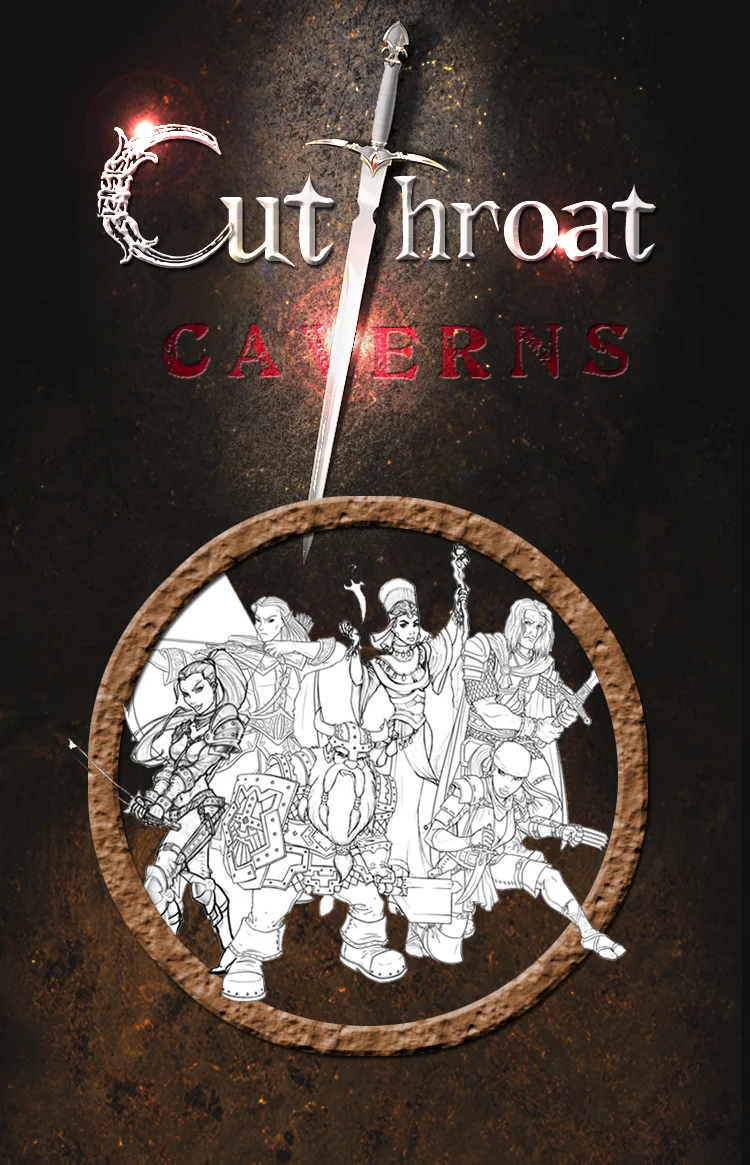
First rough concept for the Cutthroat Caverns box. Courtesy of Smirk & Dagger Games.
Process
The heart of game I set about designing myself, but I have always relied on my partner in crime, Justin Brunetto, to kick the tires and suggest areas to improve. And I try to learn something from every playtest. The design evolved over the course of a year where we debated wordings, how deadly to make the dungeon, bonus prestige and the final Encounters paired down to the best assortment.
My first step is always to mock up materials as rough as possible, for myself, where I play mock hands alone. This lets me see the game flow for the first time, identify very coarse issues, and make any adjustments before subjecting others to an overly flawed design. In Cutthroat, this initial runthrough allowed me to see the benefits of a damage stack of cards and verified the viability of printing adjusted damage along all four edges of the card, so they could be rotated to one side to show ‘half damage’ and the like.
I might ask family and friends to do one session with me, just to gauge the human element, but I never expect a great deal of reliable feedback here, as friends and family can be guarded on criticism. The real work happens with players who don’t know you. That is where all the learning is done, with all sorts of player styles.
I do not rush the process and a game is only done when it is ready. Often times, as primarily a one-man shop, I am weaving development time in after work at local game stores, on the weekends and comping and editing rules where I can find time. You can sense you are close when major rules questions begin disappearing. But for me, I know a design is done and worthy of printing when a playtest ends in a couple of the players excitedly asking me when the game will be available. If I have to ask if they like it, it probably isn’t ready yet.
The Takeaway: The design process for Cutthroat was fairly seamless. The final game was very close to the initial design, and my assumptions regarding how players would react given the situations I purposefully placed them in were dead on. Making sure the creature Encounters were balanced yet emotionally engaging was the fun part and then took some tweaking here and there.
Everyone approaches the design process differently. Some designers are more mathy, some are looking for intricate decision trees, while I stress a gut feel of gameplay delivering on the emotional impact of play. I want to see highs and lows, gritting of teeth and laughter. But no matter what your style, build and develop with your own sensibility at the heart of the matter. Build your game, no one else’s.
But be fluid, not every design is the same. Let the game itself guide you. Let playtests challenge your assumptions.
Prototyping
I come from a graphic art background, so prototyping was always second nature. I have a few tools that may not be as easy to come by for others, but there are easy replacements to be had.
First rule: First prototypes should not be pretty. You are testing core concepts, so keep it rough. You can even handwrite the cards if you want or just have black type on featureless cards. Make sure the core mechanics work before trying to make it look good.
Second rule: Editable prototypes are better than fixed, beautiful prototypes. Don’t run to The Game Crafter with your first prototype. You will be changing a lot in the process. My favorite thing for cards is to print out roughs on regular copier paper and drop them into card sleeves with a playing card backer (for stiffness). Anytime you have a rule change, swap the paper and you are good to go. Card sleeves of different colors can help separate different card decks.
Once I have a design that I’m fairly happy with, I will add a little art and design that help people imagine the theme of the game. That can impact how people perceive the game, helping put them in the world you imagine. I have often used clip art or other things “for position only” (it is good to mark it as such) before actually working with an illustrator to develop art. I would only do so once I had a very final design in place.
For chipboard tokens, game boards, etc., I tend to lay those out on tabloid (11x17) sheets on a computer. Illustrator, Photoshop and InDesign are industry standards. But you can hand draw them as well if you need to. But I typically run color lasers and then apply adhesive to the back with a Xyron machine. They can be bought at Staples and other such office stores. It is essentially a roller system that applies a uniform gummy coating to the back of your printouts, so you can then carefully adhere them to some nice art board, chip board or even heavy duty card stock. Without a Xyron, use 3M Spray Mount (light tack). Spray a very light, even coat (you don’t need much) and do so outside on a surface you don’t mind getting tacky.
Once I’ve got a solid design and developed/semi-developed artwork, I do a final comp that I can showcase with gamers, retailers and distributors. At this point, if you want to go to Game Crafter for a more professional level of finish, go for it. I don’t, but I do upgrade to clear sleeves and comp the back of the cards as well.
The Takeaway: A beautiful prototype can definitely help draw people in and get them involved in the game’s theme--but do so later in the process to save yourself some time and money.
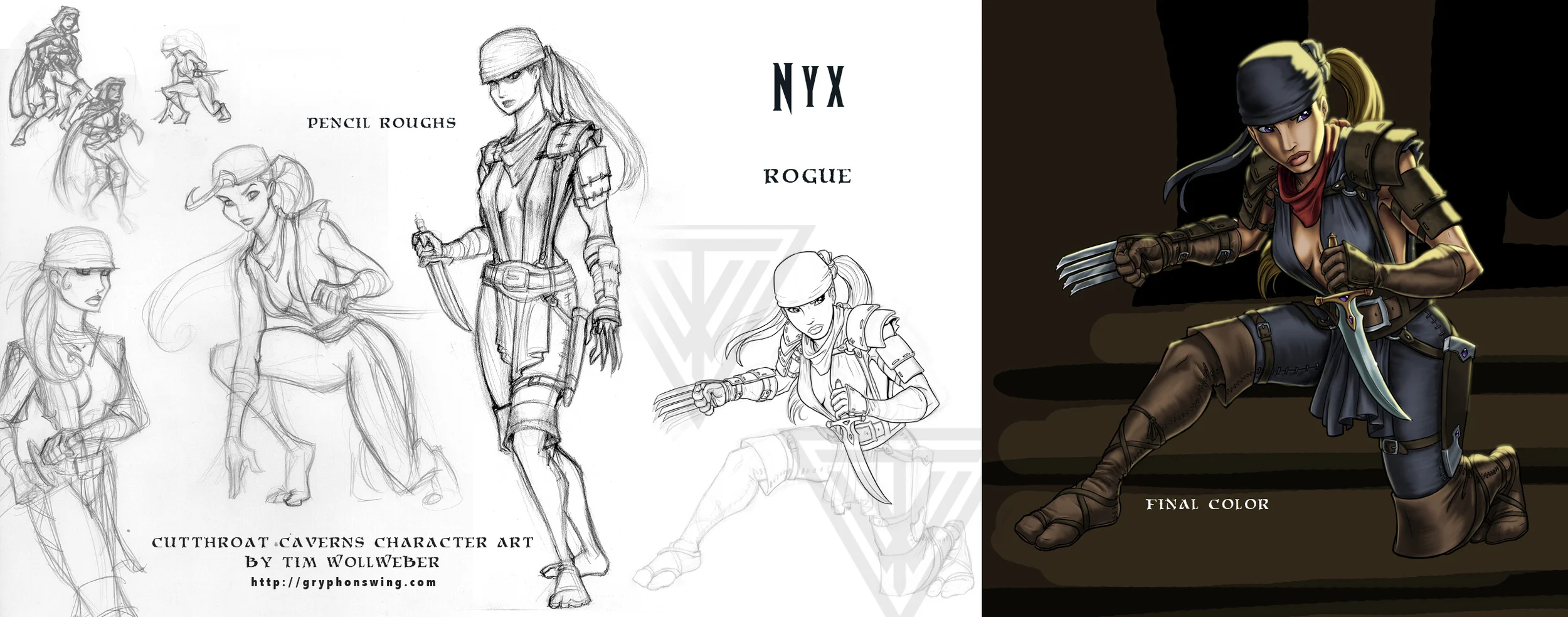
Cutthroat Caverns character design. Courtesy of Smirk & Dagger Games.
Playtesting
Until you playtest, you don’t really have a game; you have an idea for a game. It is in playtesting the game that you find all the ugly bits, prove out your concept and perfect it.
I’m big on playing with people I don’t know and often travel to board game meetup groups, game nights at retail stores and conventions to find gamers who are not friends and family. Some people go through the rigor of having playtesters write down their thoughts and ask specific questions, but I have often found that a quick conversation can be more meaningful. Let your players know that part of the test is chatting about it afterwards. If you have things you are specifically trying to get input on, by all means mention it. But a conversation will allow you to follow up with clarifications or even pull additional input from them. Try to avoid making comments or reactions that cause them to shut down. You can filter for what is useful later, but accept what you are given with open ears and an open mind. Evaluate later.
Don’t try to accommodate all the input you receive. Some will be smart, insightful and right for your game. Some you will discard as a direction you do not wish to move in. All input is important; not all is actionable.
On Cutthroat, our playtesting did indeed prove that players were interested in unique characters and asked why we didn’t have them. Most were satisfied with my answer about wanting to instead focus on the lengths players would go to achieve their selfish needs, but it didn’t stop them from requesting. In the end, I had to decide what game I wanted and why--and stuck to my guns. We reduced much of the grey areas in describing the unique rules pertaining to each creature.
Publishing
Cutthroat was the fourth title Smirk & Dagger produced. My previous games had generated just enough income to reinvest in the printing, but little else. Mind you, this was well before Kickstarter. My first games required me taking on a second mortgage to fund the printing, which took a long time to pay off, but this game scraped by on money I’d generated from the first three games. That said, I had very little available for art--and huge art demands.
The art was critical for the theme. I needed somewhat whimsical player character art to show that the game itself was light-hearted--and really awesome, nasty creature art that made you think these creatures would tear you all apart. It was the first time I had to go outside for illustrations, having used my own cartooning skills and graphic art ability on previous games.
It was important for the characters to be consistent in style, from a single artist. I found a great artist who had been working on his own comic book, with a style somewhere between Marvel and Disney art. His previous works were unpublished (officially) so I was able to work with him on a budget that worked great for both of us. We worked through pencil sketches right into final color art. I had him illustrate the characters as full body, standalone poses and planned to combine them into a composition for the cover art, to avoid having to create separate cover art.
Much as I wanted unique art for each Attack, Action and Item card, it was simply not possible, so I created graphic treatments for each, which were clean and functional. This left the creature art. I needed 25 illustrations and had largely run out of resources, certainly not enough to commission new works of art from scratch. So I decided to contact a handful of illustrators whose previously created works had caught my eye, with existing creature art that would suit the cards. All were personal projects they had done, in some cases years before. I worked out arrangements with each to feature their works as part of a very eclectic gallery of encounters. It was a unique solve and the diversity of styles became a strength for the game.
Marketing was very word-of-mouth, mostly convention appearances and reviewers whom I sent review copies to. I also submitted to the Origins awards and other award panels. Happily, the game itself did much of the work for us. It was innovative and despite a few rough spots in the rules (we’ve been through a number of improved versions) it garnered a lot of attention, earning a number of nominations for game of the year.
The art of the demo was critical in the success of the game. It takes 90 minutes to play and that is way too long for a convention booth demo. It took a while for us to figure out how to best show it. First, I created a “teaching board” with pictures of all the key cards neatly arranged. Instead of fishing out cards every time I taught the rules, I could just point to the right spot on the board. It cut teaching the game in half. Then we decided we could showcase everything about the game in just three or four encounters. We chose an example of a few very different encounters to highlight different mechanics in the game and dropped everyone’s life total in half to keep the danger level appropriate. It delivered the full experience in just 15 to 20 minutes. Still a long demo, but one that felt robust and full, and led very reliably to sales.
The Takeaway: For every game you design/publish, craft the shortest, best experience to showcase your game. Stack the deck, streamline setup, remove cards that lead to confusion, etc. The demo should be pretty consistent and show off the best aspects of the game. Above all, create an experience they will remember. I’ve always said that I never have to “sell” a game. I just have to show people what excites me about it.
Do not be stingy with handing out copies to podcasts and reviewers. Consider it part of your marketing budget, because it is--and the least expensive marketing you will ever do. Demos are the number-one best way to market your game, reviews are number two.
Customer service is critical. Professionalism is critical. Don’t be a dick. Ever. To anyone. Fans, artists, printers, reviewers and people in general. Show them your passion, treat everyone with the respect they are due, expect nothing and appreciate everything. This will always open a door--or at the very least, won’t close them.
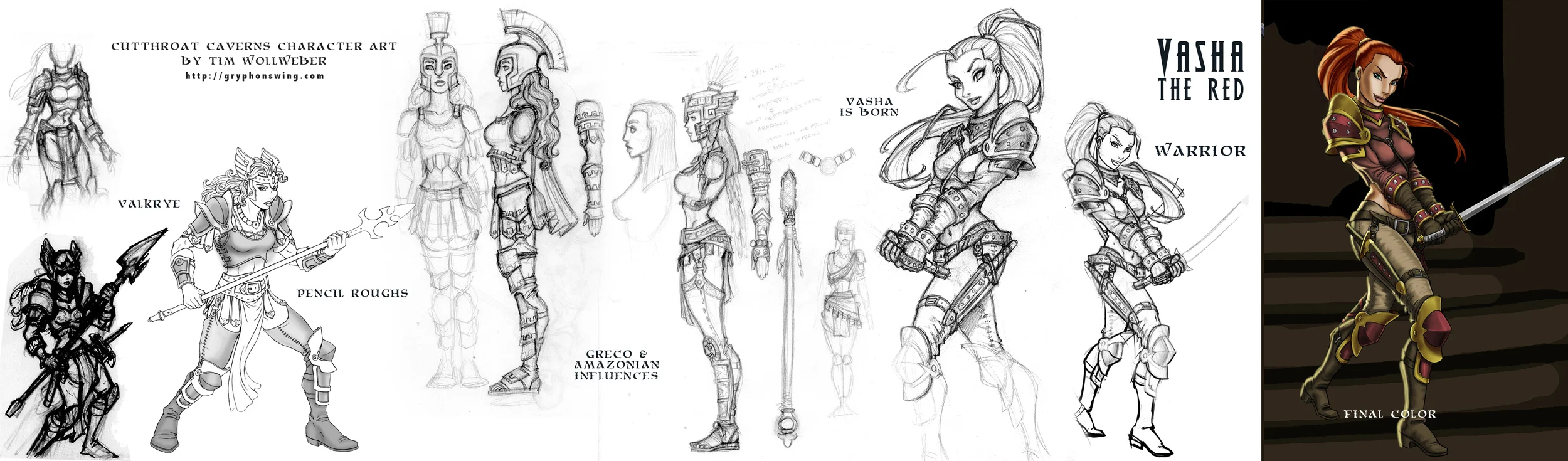
Cutthroat Caverns character design. Courtesy of Smirk & Dagger Games.
About Curt Covert
Curt Covert is the owner of Smirk & Dagger Games and the designer of Hex Hex, Run for your Life Candyman, Cutthroat Caverns, Sutakku, Nevermore and a number of other titles that prove games are more fun when you can stab a friend in the back. He still has a full-time job as a creative director for a major marketing company and a very patient and understanding family. Smirk & Dagger will have an unprecedented number of new games in 2016, including Dead Last, our social collusion game of shifting alliances and betrayals, J’Accuse!, a game of accusations, denials and murder, and Specters of Nevermore, an expansion to our card drafting game featuring 12 unique characters based on Edgar Allen Poe’s literary characters.
Cardboard Edison is supported by our patrons on Patreon.
SENIOR INVENTORS: Steven Cole, John du Bois, Richard Durham, Peter C. Hayward, Matthew O’Malley, Isaias Vallejo
JUNIOR INVENTORS: Ryan Abrams, Luis Lara, Behrooz Shahriari, Aidan Short, Jay Treat
ASSOCIATES: Robert Booth, Doug Levandowski, Aaron Lim, Nathan Miller, Marcel Perro, Matt Wolfe
APPRENTICES: Kevin Brusky, Kiva Fecteau, Scott Gottreu, Michael Gray, JR Honeycutt, Scott Martel Jr., Mike Mullins, Marcus Ross, Sean Rumble, Diane Sauer
When you should and shouldn't participate in playtests of your game:
http://www.dancinggiantgames.com/blog/external-playtesting-when-should-you-play-your-own-game
Three designers of cooperative games answer questions about co-op design:
http://www.leagueofgamemakers.com/a-cooperative-design-qa-with-industry-experts/
What to consider when naming a game:
http://www.leagueofgamemakers.com/ask-the-league-naming-a-game/
Meaningful Decisions: Doug Levandowski on Design Choices in Gothic Doctor
/In our Meaningful Decisions series, we ask designers about the design choices they made while creating their games, and what lessons other designers can take away from those decisions.
In this edition, we talk with Doug Levandowski, the co-designer of Gothic Doctor, about player choice, balancing powerful cards, endgame triggers and more.
The rules for Gothic Doctor tell players to remove any action cards they want to before starting the game. Why?
Gothic Doctor is a broad enough game that it could be good for younger gamers or gamers more interested in a light experience--and with the Partial Treatments variation in the expansion, it can be good for players who want to make more risk vs. reward kinds of decisions. With that in mind, John McNeill, the game’s co-designer, and I decided--even before the expansion--that we wanted to put this caveat into the rules.
Some players want to play more of a multiplayer-solitaire game, and some players (especially in set collection games) really hate having their sets disrupted; on the other hand, some players want to have a stronger take-that element to the game. So in light of that, we decided the easiest way to make the game fun for all different kinds of players was to give players the option to alter the balance of the action cards however they wanted.
We sort of stole that idea from Dominion. Don't want curse/attack cards? Cool! Leave them out! Want to attack nearly constantly and have high score in the game be, like, 7 points? Cool! Witches for everyone! Moats for no one!
Then, as we developed the Partial Treatments expansion, that ability to change the action cards mattered even more; the more you can affect the waiting room, the riskier it is to partially treat a patient, especially to drop a bunch of treatments on a higher-value patient. So if we had any doubt about that caveat before, giving players the ability to skew that risk/reward ratio became something we were really excited about.
What are the pros and cons of giving players the ability to change the type of experience they'll get in a game?
I think the most significant pro is that it allows players with some experience with the game to alter the balance of what will happen in the game. My friend Ian Reed and his significant other Devon are really aggressive players, so he recently told me that when they play, they take out many of the action cards that are neutral to the other player; they want that sort of experience where they can really screw over the other player even if that means low scores in the game. My wife, on the other hand, wants to play friendly games, so we take out the aggressive actions. My experience with games with variable card powers is that every player has some that they absolutely love and want to see every game--and some that have the potential to ruin the game for them. So a serious pro is letting players mold the game to the kind of experience they want to have.
A pretty serious potential con, which I think we avoided in Gothic Doctor, would come if the change to the experience could make the game unbalanced in some way. In Gothic Doctor, players can't (for example) change the number of Panaceas in the deck or get rid of one type of treatment. If they could, that would change how easily doctors could cure patients, and that would really skew the core of the game. But the actions cards don't run into that issue in my experience.
Another potential con is if there are elements that have the potential to ripple out in unexpected ways that players might not understand, especially after only a game or two. Altering the core elements would definitely lead to that--like if players could decide how many rounds they wanted the game to last for. That seems superficial, but in Gothic Doctor, it has big implications for things like the specialist and generalist bonuses.
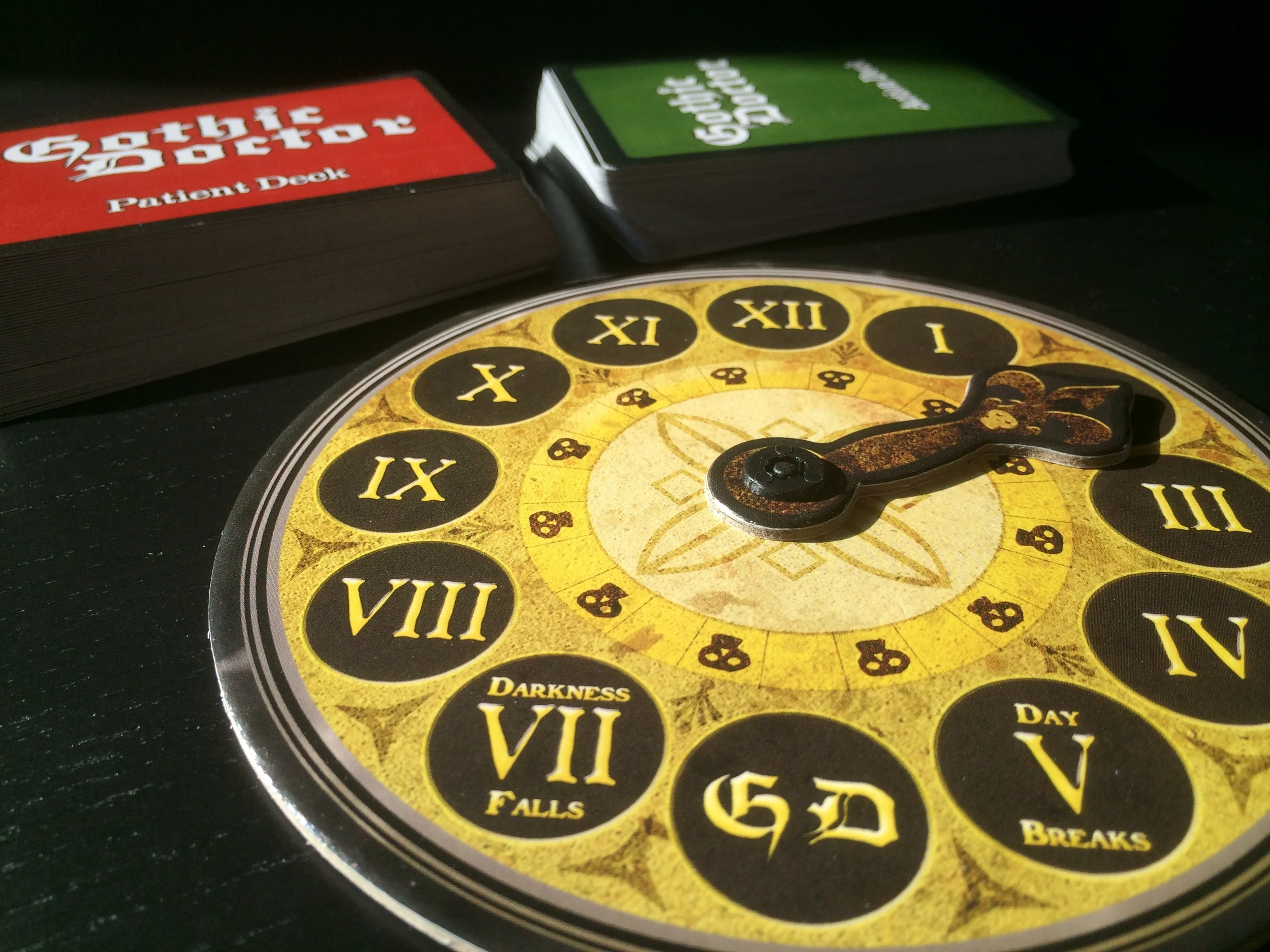
Gothic Doctor ends after a set number of rounds. Did it always, or did you test other endgame triggers?
Heh, no, it wasn't always that way, and this is one of my embarrassing first-time-designer stories. Originally, the game ended when a doctor had treated 650 pounds worth of patients. (Typically in a current game, scores range from 325 to 500 pounds--so they were much longer games.) But I really liked playing to a certain value, since the theme of the game is that you're trying to make partner in a practice, and it made sense to me for the practice to be saying, "When you've made this much, then you're partner."
John found that the people he was playtesting with were saying, "This is pretty long..." but I was absolutely dead set on keeping it, so I said, "Fine, then we lower the value!" We argued and argued about it--pretty forcefully, actually--until one day, he said, "Sit down. Play it this way." And within three rounds, I was absolutely convinced how right he was.
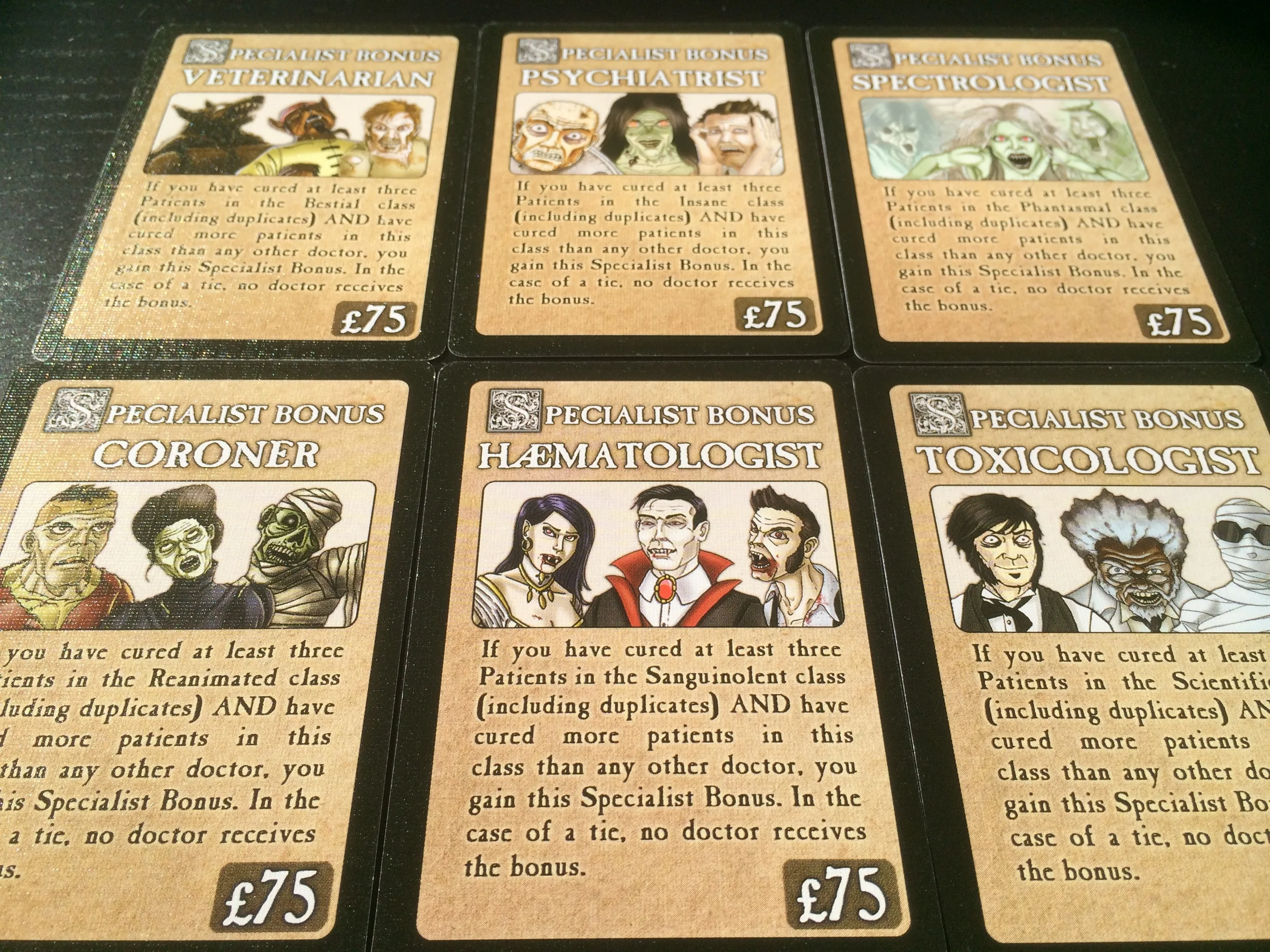
With the round-based endgame, we were able to say thematically, "You have this many hours of night. Go!" and that makes a lot of sense, too. It also prevents players from having to be counting their score constantly, which was very tedious, though we could have mitigated that with a score tracker. And, more importantly, playing to a set number of rounds gives you a strong sense of moving towards a conclusion, which is helpful in the arc of the game: "I only have two more rounds, and I need to get another Bestial patient to get that Veterinarian bonus!" or "I just have to keep my opponent from getting another Insane patient for three more rounds..." There's a lot better tension this way than, "Oh! I have enough to win! Game over."
So, the takeaway for me here was to playtest something even if you think it's going to change the DNA of your game. If it does, it might change it for the better.
We also briefly kicked around the idea of having to treat all of the patients in the deck. Super tedious... That lasted half of one playtest.
Are there ways a designer can tell what type of endgame trigger is best for a particular game?
Experimentation is really the best way, I think. If you can think of something to try, my really strong stance is that you should just try it. After one test, it might be clear that it won't work--but even if it stinks, it might open up some other ideas that could work in other ways.
But along with that, I'm a strong advocate of the fusion of theme and mechanics. So if there's a thematically relevant endgame trigger, that's the first one I'd test. More importantly, though, the game has to end before players are bored with it. So thematic concerns have to be adapted to make sure that the fun's still there. Luckily, theme can usually be massaged to make that work.
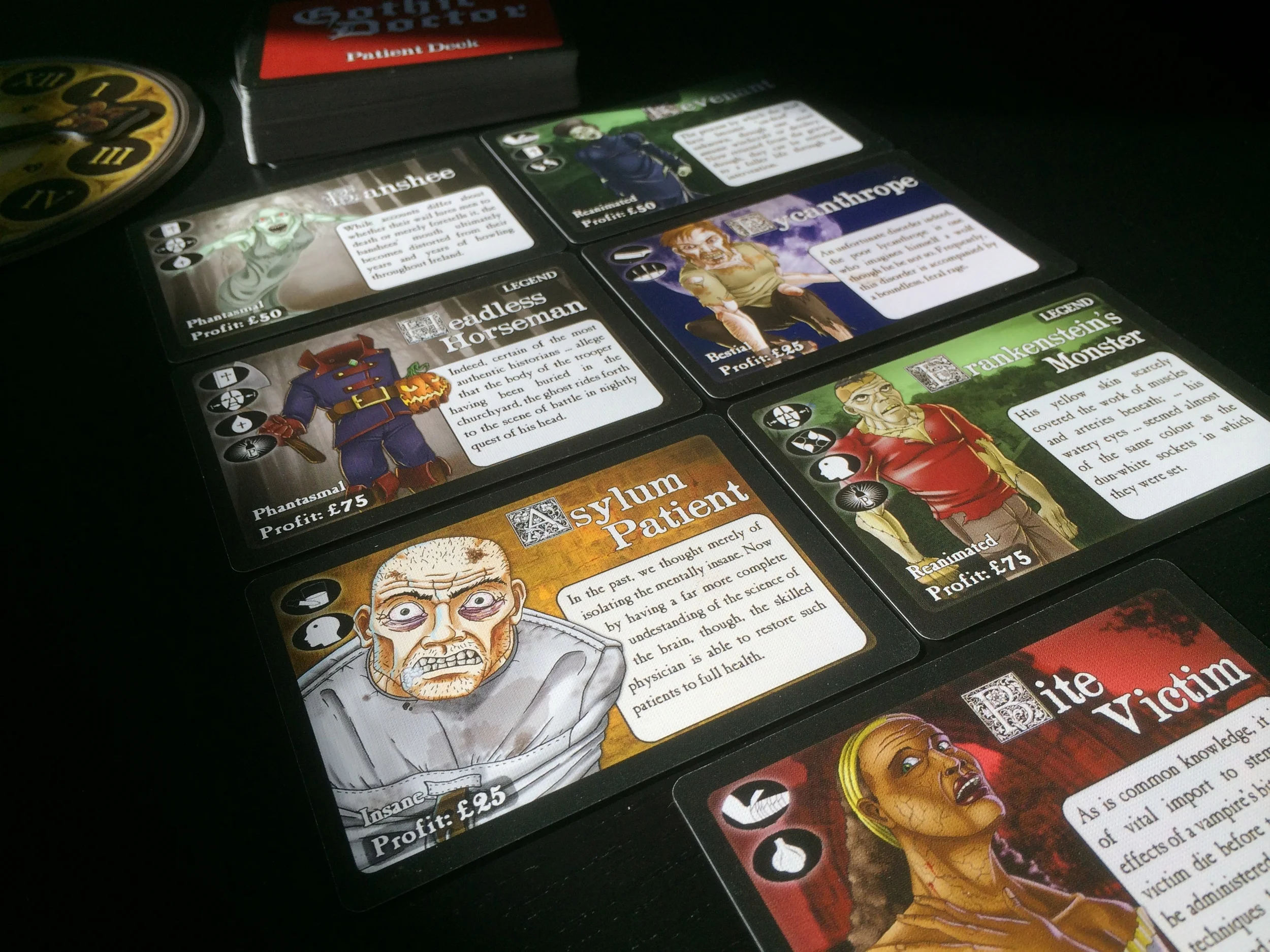
When drawing cards, players may draw from either the treatment deck or the action deck, in any ratio they choose. This gives players the flexibility of crafting their hand of cards. Why did you divide the cards this way, and why did you make both card types contribute to the seven-card hand limit?
This decision came down, again, to player choice--but it also had a lot to do with controlling randomness in the game. Originally, the decks were shuffled together and you just drew from them--but it could be really, really frustrating to keep drawing action cards when you need to treat a patient. So we split the deck.
In keeping with the elements of choice that we worked into the game, we wanted players to be able to balance their hands however they wanted. I mentioned how aggressive Ian and Devon are with each other; they're heavy action card users too. Some people don't use them at all (which is a thing that newer players tend to do before they see just how much some of them can affect the game). But ultimately, that's one of the strategic elements in the game: If you can cure one patient in the waiting room with the cards in your hand, do you take an action card? They're very powerful, but almost all of them are conditionally very powerful--higher risk, higher reward. Or do you take another treatment card to have a more balanced hand? John and I were really, really happy with this change and the control it gave players over the management of their hand.
How can a game's rules accommodate different players' preferences? Should there be limits to how much flexibility a game gives players?
Player interaction is a key way to do this; it's something that I've picked up from playing Jay Treat's designs (especially Grandeur and Merchants of Araby) and your Sultana, which has one of the best interactions I've seen. Players can decide in these games how much that interaction matters. In Merchants, you can build your engine on your own, or you can work very collaboratively, especially in early rounds. In Sultana, you and your opponents get to choose which path(s) to victory you're focusing on.
At the same time, though, with high collaboration games, there's a sort of paradox there: It can also limit the ability of players to exercise their preferences. When what other players do influences optimal play, it makes it so that what they do alters the options you have, usually not increasing them. But at the same time, it also expands them. It's weird that way.
Another way to accommodate players' preferences, of course, is modular setup--anything from altering what action cards are in the game to changing the setup of the board to encourage or discourage certain paths to victory. And then of course there's something like 504 where even the core mechanics are variable, though I haven't checked that one out...yet. Actually, given how different 504 games can be (from what I understand), that's like saying that you can accommodate players' preferences by letting them choose what game they play...
In terms of limiting flexibility, I think choice should be bounded by the fun in the game. To some extent, that's about protecting players from themselves. Even great, great game designers have ideas that sound awesome in their heads but wind up being unmitigated disasters on the table. So I don't want any of my rules to be so loose that a player could make the game unfun. There are house rules, of course--but then players would know, hey, this isn't allowable in the core.
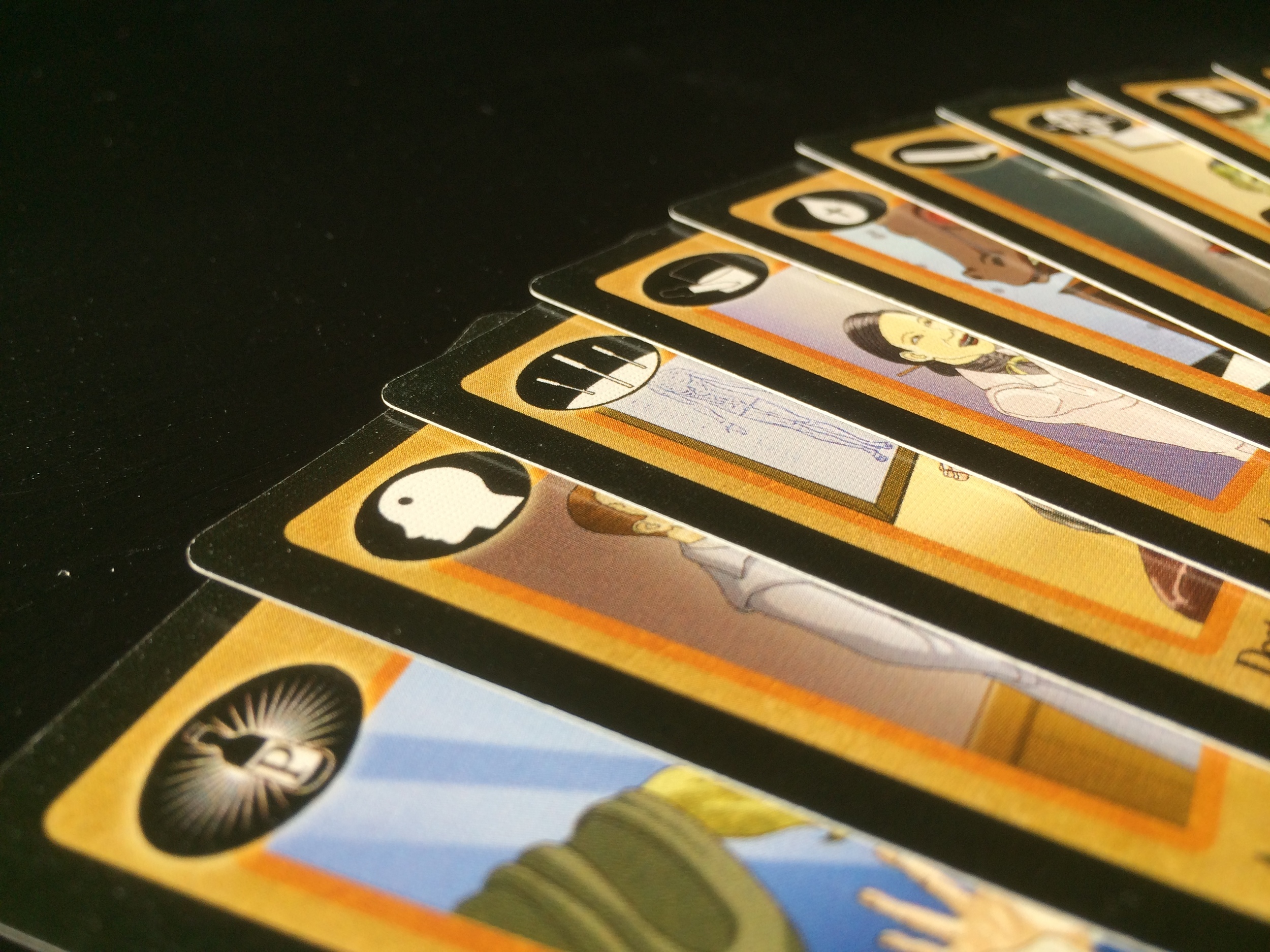
The Panacea cards are especially powerful because they're required to treat the most valuable patients, and they can be used as wildcards in place of other treatments. How does the game counterbalance this?
Super powerful--and unlike the action cards, Panaceas aren't conditionally powerful. They're powerful every time you treat. So, to counterbalance that, we did a few things. First, drawing them face up costs two draws instead of one, decreasing your hand size until the end of your next turn.
Second, you need them in order to treat the more valuable patients, so they serve more than one function in the treatment process.
Third, we put 13 of them in the treatment deck--while each other treatment card only has 5. When you have a very powerful card, I think you want to make them more widely available to reduce the imbalance based on luck for the number that players draw--as much as is possible in a game based, in some ways, on the luck of the draw.
Fourth, the fact that they are so powerful leads players to have to make decisions about whether to use them as a wild--and when. People tend to not throw them around given how valuable they are, so that helps a bit to mitigate it.
In the playtesting, we tested towards the end for whether having more Panaceas pass through their hands correlated with higher score. They didn't, so, good to go!
Are there go-to ways of counterbalancing powerful cards that designers can keep in mind?
Conditional power is a big one, for sure. For example, one really powerful action card allows you to take a treatment card into your hand when an opponent uses it. So, it's basically a free Panacea--but you have to wait until an opponent drops a Panacea to use it. Sometimes that's nearly immediately, but I've waited more than three rounds to be able to use that card as it takes up space in my hand. And since that's keeping me from having one extra card to create a set, that's a big deal. So making a great card only actually great in a specific situation is good.
The more powerful the card has the potential to be, the rarer the condition should be. But there's also a balance to that. A card that's so, so rarely useful makes it so rare that having it at the right time becomes more luck than calculation. I don't have the exact number here--I think playtesting is the trick here. Mathing it out is great, but ultimately, I think it comes back to having it feel subjectively right to most players during actual games.
Another way is making them more difficult or costly to acquire, as discussed above--though it could also be more expensive to use. One of the things we toyed with was forcing players to spend 25 pounds to use the Panacea, but that proved to be too much of a disincentive. But if a game employs action point allowance, having to spend more action points to use more powerful cards is a way too.
Mitigating the ways in which cards are randomly acquired is important too. If it's all blind draws, then more powerful cards are more problematic since acquiring them or not will always be luck-based.
Cardboard Edison is supported by our patrons on Patreon.
SENIOR INVENTORS: Steven Cole, John du Bois, Richard Durham, Peter C. Hayward, Matthew O’Malley, Isaias Vallejo
JUNIOR INVENTORS: Ryan Abrams, Luis Lara, Behrooz Shahriari, Aidan Short, Jay Treat
ASSOCIATES: Robert Booth, Doug Levandowski, Aaron Lim, Nathan Miller, Marcel Perro, Matt Wolfe
APPRENTICES: Kevin Brusky, Kiva Fecteau, Scott Gottreu, Michael Gray, JR Honeycutt, Scott Martel Jr., Mike Mullins, Marcus Ross, Sean Rumble, Diane Sauer
Advice for designing a game system that will support many possible games:
http://theinquisitivemeeple.com/2016/05/13/the-birth-of-a-game-system
Loops in board game design: core loops, feedback loops and more:
https://www.buzzsprout.com/48513/380368-episode-15-loops-in-game-design
10 places to find playtesters:
http://galvanizedstudios.com/2016/05/09/finding-playtesters/