






Best practices for improving the structure, style and clarity of a rulebook:
I like thinking games, but even there, you don't want to make people think unnecessarily, to think about things other than the game's strategy. And for mass-market games, people rarely want to think much. Here I discuss the different meanings of "don't make me think."
What it means when a player says "Don't make me think"
Meaningful Decisions: Donald X. Vaccarino on Design Choices in Dominion
/In our Meaningful Decisions series, we ask designers about the design choices they made while creating their games, and what lessons other designers can take away from those decisions.
In this edition, we talk with Donald X. Vaccarino, the designer of Dominion, about deck-building, expansions, politics in games, variable setups and more.

Dominion established deck-building as a game mechanism, and many other games have sought to play around with the formula. How did you settle on the core elements around drawing, purchasing, discarding and reshuffling?
The premise was that you were building a deck while playing, and that everything was in the deck.
Since everything was in the deck, resources were in the deck. I didn't want to have it be too easy to get a small deck; so resources stay in the deck, you don't lose them. They're income.
Initially I considered having a variety of resources. It's simpler to have one, and means you don't draw a bad mix of them.
Initially I considered having to play a card to buy a card. But you'd always need those cards; maybe you'd lose yours or something and have nothing you could do. And some turns you wouldn't draw one. So, you can buy a card every turn, it's built in. And Copper costs $0, so you can always gain a foothold.
If you just drew one card a turn, it would take forever to see the deck you're building. So, you draw 5 cards a turn. You recycle everything so you can keep drawing it.
Initially I thought the choice of cards to buy would be like a line of cards, and when you buy one it's replaced. I worried though that too much of the game would be having a good card turned over when you got first shot at it. When it came time to try the game, I hadn't solved the problem. So I just put everything on the table at once. I figured, it would be easy to find the broken cards, and if the game worked I could refine it later. Of course it turned out we liked being able to buy everything. Then when I added more cards, I limited it to 10 that vary from game to game, because it's hard to keep track of even 10 different things, and 10 changing gives you plenty of variety.
You play a single Action card on your turn. This was a very simple approach I'd already used in other games. It meant I could have cards that let you break that rule, which was a significant attraction. Similarly only getting to buy one card is simple and creates the opportunity to make cards that give +1 Buy.
It's hard to shuffle a very small deck. So, you at least start with 10 cards. I didn't want to make any decisions for you for how your deck was built; so the 10 cards are bad.
Since everything was in the deck, victory cards were in the deck. I made three sizes thinking you'd be able to go for a faster or slower strategy. In the end the game aims heavily towards Provinces in order to keep the game long enough to have fun building your deck.
I needed an answer to the question, what if a pile runs out? At the same time I needed an end condition. So the initial end condition was, the game ends when any pile runs out. Later I changed it to fix a problem (if two players went for Duchies, everyone had to).
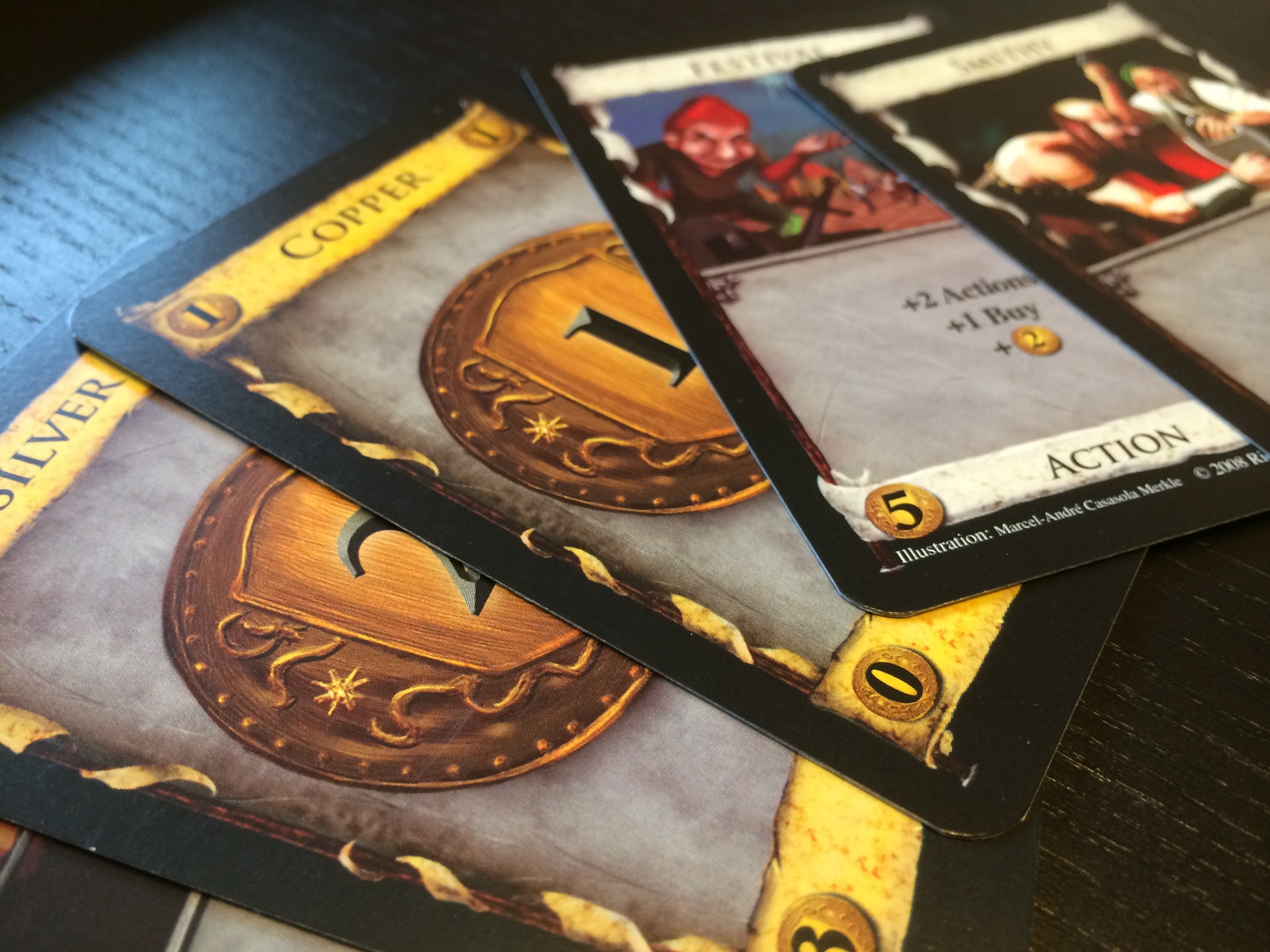
You've designed numerous expansions for Dominion. Did you have expansions in mind when you made the base set, and did you have particular goals when you set out to make each expansion?
Initially there were just some cards. There were enough cards that I split it up into a 25-card main set and two 15-card expansions. I moved on to other projects, but my friends just wanted to play Dominion, so I expanded the expansions and made more of them. When I showed the game to Rio Grande Games, I had a 25-card main set and five 20-card expansions.
The expansions have several goals.
- They try to add something new and exciting to the game, while still being just more cards.
- They try to play well by themselves. My feeling was that some people buying an expansion would initially play the expansion by itself.
- They try to have certain game elements at certain frequencies. For example, about 1 in 8 cards gives +2 Actions or otherwise plays extra cards ("villages"). This is essential in order to have it be that, whatever mix of expansions you have, you'll get a decent game experience.
What strategies can designers use to find new design space for an expansion for their game?
An overriding concern is that the expansion be good for the fans of the game. You don't want to veer off too much. People who didn't like the base game aren't trying the expansions, so it's not like, say, a bidding-themed expansion could open up Dominion to bidding fans. The one thing you know about the audience for your expansion is that they liked the base game. So the expansion should shake things up some, but stick pretty close to the main set's premise, especially in terms of what the fun part is.
There are two kinds of expansions: ones that really change the game, and ones that are just more stuff. I have leaned heavily on just having more stuff. Dominion has cards, and you don't use them all each game, so an expansion can seamlessly add more cards. Kingdom Builder has boards and you don't use them all; the expansions add more boards. But other people also make expansions that aren't like that; Cities & Knights is a big change to Catan, not just more of the basic stuff.
I don't know what advice I can give on expansions that really change things. I personally haven't done them, and might lean more towards making a spin-off rather than an expansion there.
For expansions that add more of what you've got, there are several good basic ways to find stuff to do.
- General functional theme. Anything you can do normally here and there, you can focus on doing a lot of in one expansion. Wizards of the Coast does this a bunch with Magic; any set may have artifacts, and then one set will have lots and lots of artifacts.
- Program flow theme. This is where there's some basic what-you-do logic that you do a lot of. This is a major source of Dominion expansion themes. Intrigue has "choose one" as a theme; Seaside tries out "now and next turn"; Hinterlands has "when you gain this"; Dark Ages has "when you trash this."
- Qualifier theme. Cornucopia has a variety theme; several cards care about cards being different from other cards. It's an aspect of things rather than what-you-do.
- Flavor theme. You can start with flavor instead of functionality. This is a better fit for games that allow more complexity; when you have very simple cards, it's harder to hang meaningful flavor on them. Again, Magic does this one a bunch.
- Break conventions. In Dominion the convention is that Victory cards don't do anything else, they're just worth points at the end. Intrigue breaks that convention by having Victory cards that do things. A good trick here is to establish conventions, planning to break them later.
- Add data. Adding data to the game requires components to track the data, but it's otherwise a great, always-available way to find new things to do.
- Add a value. Alchemy adds Potions as a resource. It gives you a new potential cost for cards.
- Add rules. This makes your game more complex, and if you add both data and rules, it's like you added a game to your game. Still, sometimes adding a rule will get you somewhere good. Guilds adds both coin tokens and the rule that lets you trade them in.
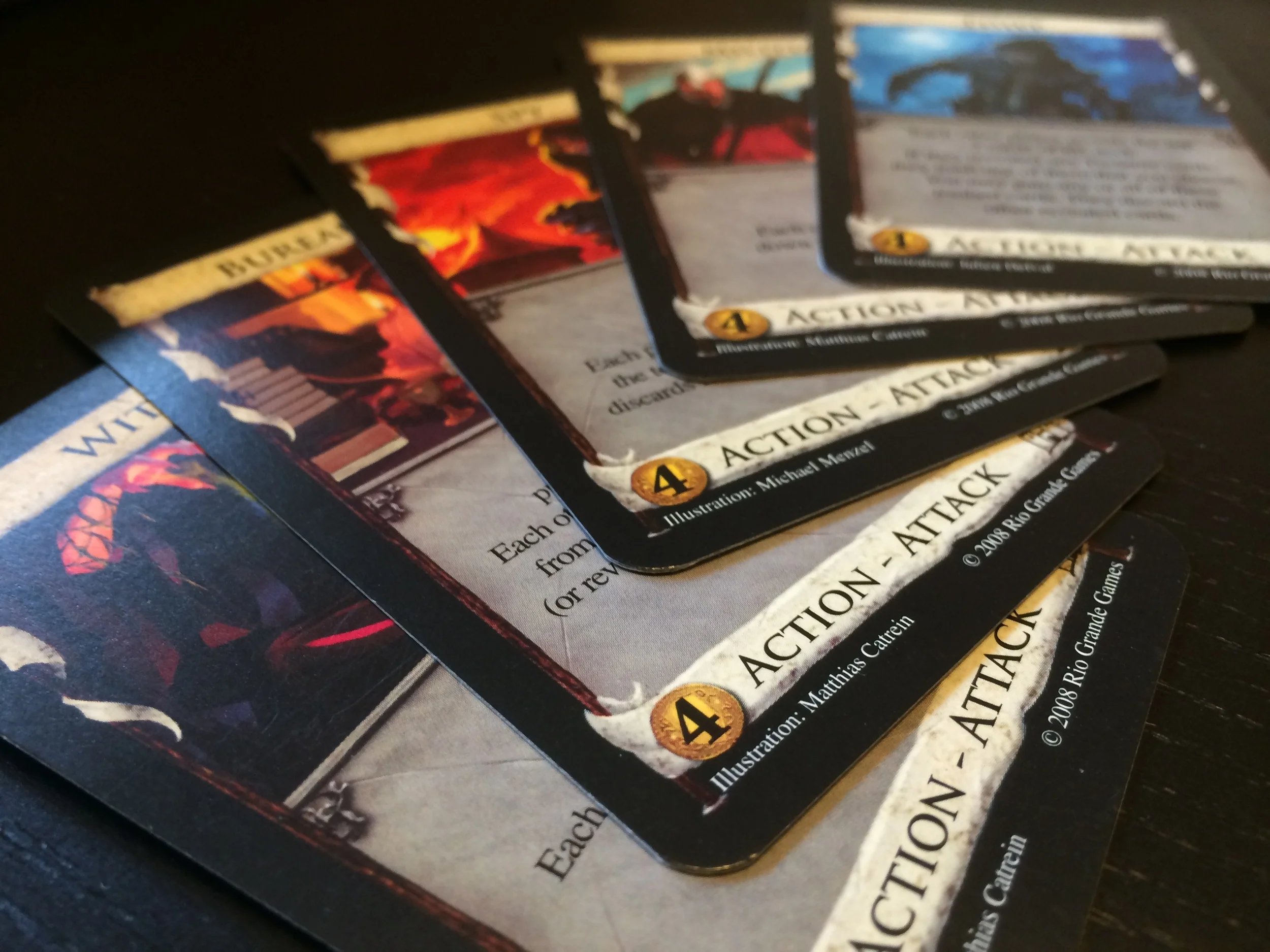
Attack cards are the most direct form of player interaction in Dominion. Without them, player interactions are much more subtle. Did you seek to encourage certain types of player interaction in Dominion, or did you want to allow the players' preferences to determine this?
Dominion is a game where a lot of the interaction is "incidental," meaning, it comes from the card mix rather than the rules. To make sure there will tend to be a good amount of interaction, I have a certain proportion of interactive cards. It's gone up slightly over the years, though the percent that's attacks has gone down.
There are a few different kinds of interactive cards, not just attacks.
- Attacks!
- Cards that give something to other players. Council Room has the other players draw a card.
- Cards that get data or a decision from other players. Contraband has the player to your left make a decision that limits you.
- Cards that interact with something the players share. City cares about empty piles, which all players affect.
- Cards that push competition for the cards. These are more mild but I count them for a fraction. For example, Gardens can cause us to compete over the pile.
- Cards that feed off of attacks. I don't count these towards my quota since they don't increase the percentage of games with interaction, but they do interact in games with attacks. For example, Moat stops attacks.
I am strictly anti-politics. By "politics," I mean situations in a game where it's possible to talk other players into decisions that benefit both of you to the detriment of other players. You can't completely get rid of politics from interactive multiplayer games (that aren't reduced to 1-2 teams). You can dial it way down though, and that's what I do. So Dominion's attacks and interactive non-attacks all involve everyone else. Militia makes everyone else discard down to 3; you don't pick a player to hose. For me this is just key to enjoying the game. There are players who like to pick who to hose and, well, there are games out there that cater to them.
So: I try to have a good amount of interaction (though it varies with the cards used); I specifically avoid politics; and otherwise it's just down to what I can manage to do on cards.
What can designers do to encourage or discourage certain types of interaction, or to put the level of interaction in players' hands?
My games strive to have variety. Some of them get it in a player-selected way--the varying cards in Dominion, the varying boards in Kingdom Builder. That is all I do to give players control over how much interaction the game has. Anything else is just play style.
I am interested in most ways players can interact. What I do not like, again, is politics.
The main way to reduce politics is to remove the common ground. When I attack you in Risk, every other player benefits. They can try to talk me into attacking you; it's good for them, it's good for me. In Dominion, Witch attacks everyone else; no other player shares in benefiting from me playing it.
Hiding information can also reduce politics. When you are choosing between playing Militia or Adventurer and I already have 3 cards in hand from someone else's Militia, I could try to talk you into the attack, which would hurt at least one other player but not me. But I don't know that you're considering those options until after you've decided.
Simultaneous decisions involve hidden information but further reduce politics. We're all busy during the time I'd spend trying to talk you into a mutually beneficial attack; I don't want to reveal what I'm doing at all via saying what I want you to do.
There are more extreme measures. You can reduce decision-making; reduce interaction period; have all players on one or two teams (a co-op or team game).
Encouraging interaction is not an issue. If the game provides ways to interact, well, if they're mandatory everyone will do them, and if they're optional then the people who enjoy them will do them. Providing ways to interact is important, but people need no encouragement there.
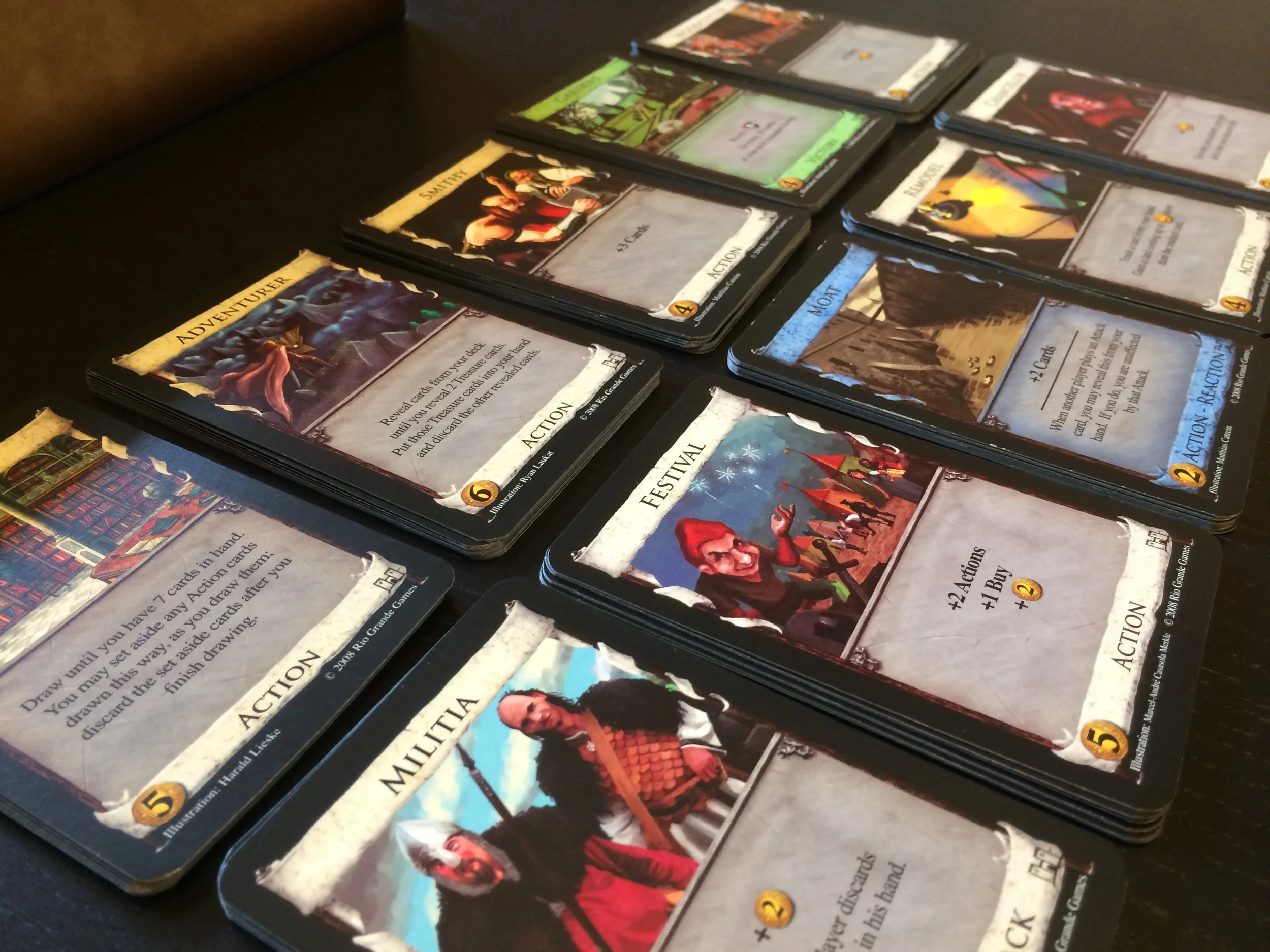
Dominion allows players to choose which card types to include in each session, giving the game a great amount of variability. There are also suggested setups. How did you determine what options to give players?
I tried to keep the set-up simple. The simplest thing is to have one kind of thing that varies, so I try that first. For some games you might be stuck having multiple kinds of things to vary, but this wasn't necessary in Dominion. For Kingdom Builder I vary the scoring separate from the boards.
I try to have games vary as much as possible but not too much. I don't want it to change so much that it's not that game you like, but otherwise I want to really shake things up.
My expectation is that, when there's a set of things to pick from randomly, many people will pick randomly! So that does affect what things are in the set; for example, if something is no good for new players, it might be stuck waiting for an expansion (or never happening). If a combo is too dominating, you might have that combo, so I have to fix it.
The suggested setups, after the first game one, exist because the thought was that some people might like them, as a way to not just jump into pure random. Originally I did not put much work into them; after all, the game is supposed to work with random cards. So I picked cards that went together in whatever ways and they were played once each and that's that. For much later sets, it was clear some people played all of them, and I started playtesting them and tweaking them a little. They are still not all that polished; again the game is supposed to work with random cards, and if it does then these lists will work too.
How much guidance should designers give players in variable setup? Do they need to be wary of an abundance of variety creating an unpredictable experience?
It's a concern in two ways.
First, you want the first game to be as good as possible. If you leave it up to chance, it will sometimes be the very worst case for a first game. So, just specify what portion of the variable setup to use for your first game. Dominion says, play with these 10 cards.
Second, there are all the other games, after the first game. If there's something you need in the game, you need to make sure it's there. For example if it was important to always have a +2 Actions card in Dominion, and I didn't want it to always be the same one, then there would need to be, say, a separate pile of those, so you took nine random regular cards plus one random +2 Actions card. It's nice to avoid having to complicate the set-up like that, but you may have to.
Players can play with whatever cards. If they pick randomly they'll see certain things as often as I like them; for example, a typical game will have a +2 Actions card, but some games there won't be one, for a different experience. But some players may wish to always have +2 Actions, or always have a defense if they have an attack, or whatever, and that's fine. They'll know how much they like it and can stop doing things they don't like. They can always go back to random.
The cards in the game almost all directly help you build up. So it's hard to have a random set of 10 that doesn't give you ways to move forward (without just buying treasures). A big trick here is that smaller effects will have basic resources attached, like the +$2 on Militia.
Cardboard Edison is supported by our patrons on Patreon.
SENIOR INVENTORS: Steven Cole, John du Bois, Richard Durham, Matthew O’Malley, Isaias Vallejo
JUNIOR INVENTORS: Stephen B Davies, Luis Lara, Behrooz Shahriari, Aidan Short, Jay Treat
ASSOCIATES: Robert Booth, Doug Levandowski, Aaron Lim, Nathan Miller, Marcel Perro
APPRENTICES: Kevin Brusky, Kiva Fecteau, Scott Gottreu, JR Honeycutt, Scott Martel Jr., Marcus Ross, Diane Sauer
Taking feedback: How to know whether your game needs "one more thing":
http://www.buildingthegamepodcast.com/2015/11/22/episode-182-one-more-thing-and-stick-fighting/
How to identify and work with the "special sauce" that makes a design interesting:
http://cardboardarchitects.libsyn.com/episode-12-special-sauce
Guest Post: The Hidden Work of Game Design
/By Doug Levandowski
In a past article on jealousy, I talked about perceived luck as a cause of jealousy. I didn’t really delve into the root cause of what we perceive as luck too deeply, so I wanted to do that here. I think what it comes down to is “hidden work”--things that people do that either fly beneath the radar or that hide in plain sight.
The best way, I think, to explain this is from a quote from one of my favorite plays, “Master Harold”…and the Boys, a scathing critique of Apartheid South Africa. One of the recurring motifs in the play is ballroom dance, and in an early scene, one character, Sam, tries to coach an obstinate Willie in the ways of ballroom dance. Willie does not take criticism well…
WILLIE: How can I enjoy myself? Not straight, too stiff and now it's also glide, give it more style, make it smooth . . . Haai! Is hard to remember all those things, Boet Sam.
SAM: That's your trouble. You're trying too hard.
WILLIE: I try hard because it is hard.
SAM: But don't let me see it. The secret is to make it look easy. Ballroom must look happy, Willie, not like hard work. It must . . . Ja! . . . it must look like romance.
WILLIE: Now another one! What's romance?
SAM: Love story with happy ending. A handsome man in tails, and in his arms, smiling at him, a beautiful lady in evening dress.
WILLIE: Fred Astaire, Ginger Rogers.
SAM: You got it. Tapdance or ballroom, it's the same. Romance. In two weeks' time when the judges look at you and Hilda, they must see a man and a woman who are dancing their way to a happy ending. What I saw was you holding her like you were frightened she was going to run away.
Sam goes on to explain that romance is the magical moment when something that takes great effort appears effortless. It’s a great play and literally everyone should read it. Or watch it. Or both.
But Sam’s concept of romance gets to the root of the reason that I think so many people think that luck plays such a big factor in getting published or making a great game--sometimes very quickly. It isn’t that great games burst out of their creator’s heads fully formed like Athena. The truth is that a lot of the work that happens in the gaming industry either happens behind the scenes or is romance--it doesn’t seem like work. It hides in plain sight.
What then should we know about “hidden work” that can help make us better designers?
We don’t see practice--but practice is vital.
When a jazz improviser picks up an instrument and starts playing, it seems like magic. Over the summer, I took a vacation with a friend of mine who’s a professional flutist, and he practiced scales for about an hour each day. Nobody’s really magical; people who are good just practice hard. Malcolm Gladwell argues that 10,000 hours of practice will make someone an expert, and even if that isn't necessarily true, practice still accounts for (according to that study) about a third of the variation in ability levels.
The same is true of game design. Every game you design is practice for the next one. When JR Honeycutt and I designed Unpub: The Unpublished Card Game in about a week, that was because it was about the 30th game we’d designed (combined total of stuff in some playable state…not published or as a design team…yet...). On the other hand, the first game I designed took me and the co-designer about a year and a half, and, on average, we worked on the game for about two hours each day.
The difference is obvious: practice. As I did BoardGameGeek’s 24-hour contests (the equivalent of a jazz solo, I’d say) once a month for a year, I got better as a designer. Nothing from those contests was a finished design, but each was a way to practice designing in a compressed, quick way. If you’re looking for ways to practice, then look no further than here. Or, check out Boardgamizer for a random set of mechanics, theme and victory conditions and just practice.
Most importantly, don’t be afraid to start things that don’t wind up going anywhere. A design that ultimately doesn’t work can still be a great exercise--and we can learn quite a lot from our failures.
“Good writers borrow. Great writers steal.”
Since I can’t find the original author of that quote after 20 seconds of Internet research, we’ll just say that one is unattributable--but that doesn’t make it not true. In English teaching, we call this writing from a model. Look at how Austen used free indirect discourse and try that out. Look at how Remarque used imagery and try that out. Borrow--or outright steal.
We can do the same thing in game design. You don’t even have to start from scratch. Take a game you like and change it in some meaningful way--or take one that you don’t like and make it good. One of my first design projects was trying to make a good two-player version of Catan using the original components. I wouldn’t publish it--both because it’s not my original game and because I couldn’t make it work. Still, it was a great exercise--and excellent practice for future designs. I learned a lot about what makes two-player games work--and what prevents them from working. In some ways, it was a way to prepare myself to design You’re Fired two years later--but by the time I got there, all that work was hidden. It seemed like the core elements of You’re Fired happened quickly while I was watching Netflix with my wife.
Your first one won’t be the best one--and it takes a lot of time to do things quickly.
It’s more or less established game design law that designers don’t think their first design is their best--even if it’s the one that they put the most work into. My theory, which was very true for me, is that because it’s their first, new designers don’t think they’ll ever have another idea. But you will. I promise.
In this respect, I think that going back to jazz is a particularly good way to shift our thinking as designers. No jazz musician does a single solo and goes, “Weeeelp, that’s it. I’ll never be able to do another one of those,” or even thinks that before they start it. They know this is the first of many. What makes it so tough to think about game design this way? I’d say nothing--just our own hangups.
So, especially if you’re starting out, give yourself permission to not get the first one quite right (but do listen to feedback from experienced designers to make it better). And, most importantly, give yourself permission to put in a lot of work that feels impossibly hard, knowing that your next one (and the one after that, and after that, and after that) will be better and easier--more like romance.
For example, during the designer dinner at Unpub 5, JR had an idea for a game based on someone mishearing names. Four hours later, he told me that he’d made a prototype and wanted me to play it, but I told him I was too tired. The next morning, he said, “Hey, that game I made yesterday? I sold that last night.”
Anyone who doesn’t know him might be tempted to say, “Man, that’s lucky. I guess they wanted any game and just signed something!” or “It’s lucky that the game turned out so well so quickly.” But that’s practicing for years. It takes a lot of work to make design look that effortless and to make it possible for him to design so, so quickly.
Start looking at playing games as work.
Playtesting counts as work on a design. Of course it does. But can you actually quantify how many hours you’ve spent on your current design? And when you’re sitting at a table with your friends, laughing, eating Doritos, throwing things at each other, and giving each other feedback, does that feel or look like work?
There’s the old saying that if you love what you do, you’ll never work a day in your life. That saying is dumb. It won’t feel like work, but you’ll be working your buns off. Csikszentmihalyi (good luck saying that one--I used him in my dissertation, and even I can’t get it right) studied motivation and found that when people are meaningfully challenged at a level commensurate with their skill, they enter a state that he calls “flow”--where they are intrinsically motivated to continue working on something. In this state, people will get absorbed in their work and will continue working long past when others would stop, without really realizing how hard they’re working.
As game designers, we’re both good at what we do (if I do say so myself) and exceptionally challenged by the task at hand, but it’s never outside of our ability. It’s just a matter of how quickly we’ll improve the game. Still, it always looks like romance because we’re laughing and throwing Doritos while we work.
It’s even the case that, indirectly, playing other games makes you a better designer. Of course, if I’m playtesting for someone and giving them feedback, we’re honing our skills as designers in obvious ways. In the same way that the students who read the most are the best writers, though, so too are the people who play a lot of games better designers. In short, you see more of what works, what doesn’t and what drives engagement with a game.
So, bottom line, just start designing. Don’t worry if it seems like a specific project won’t go anywhere. Co-design and work with someone you respect. Or design on your own. Or both. Just keep designing. But first, go read “Master Harold”...and the Boys because it’s so damn good.
Two views on running a publishing company:
Stephen Buonocore on Breaking Into Board Games: http://breakingintoboardgames.libsyn.com/breaking-into-board-games-episode-5
Jamey Stegmaier on the Happy Mitten Podcast: http://www.happymittengames.com/68/
Todd Sanders on game design contests, gaining visibility in the community and more:
https://boardgamegeek.com/thread/1474186/board-game-designer-interview-2-todd-sanders-dumar
Advice for iterating on a design:
http://www.justingary.com/core-design-loop-step-6-iteration/
Advice for working with a design partner:
http://www.buzzsprout.com/48513/325243-episode-6-designing-with-a-partner
Meaningful Decisions: T.C. Petty III on Design Choices in VivaJava Dice
/In our Meaningful Decisions series, we ask designers about the design choices they made while creating their games, and what lessons other designers can take away from those decisions.
In this edition, we talk with T.C. Petty III, the designer of VivaJava: The Coffee Game: The Dice Game, about balancing different strategies, dice manipulation, player engagement, variable abilities and more.

Players in VivaJava Dice will advance on one of two tracks each turn: performance points, which bring them closer to victory, or research points, which let them build a game engine to score more performance points. How did you settle on this dual-track framework and balance both approaches?
The key to making VivaJava Dice feel balanced even when there is this weird and major randomization agent called dice is to balance the ways to score points.
I wanted players to have an obvious and easy way to score points: make coffee blends. But, I also wanted a way for players to build their own engine with little interference from other players: Research. What makes the game an unsolvable, interactive puzzle is that your choices can impact other players’ choices on a tactical level.
By making the most obvious way to score also the most vulnerable to player interaction, it provides an interesting short-term goal. Enter the king-of-the-hill mechanic. Players can create a Featured Blend with their coffee dice to score major points, but if another player is able to make a better Featured Blend, they can replace your Blend before those points can be locked in at the start of your next turn. Also, to make sure that the decision matters on either side, when a player decides to risk their Featured Blend, they lose their ability to Research. So, while an aggressive player may be scoring points, they cannot invest in abilities. I also added a second Blend called the Rainbow Blend which is even more volatile, but allows the player to both score points and take Research.
Research not only gives players new abilities, but it allows them to score points as well by reaching the end of these tracks. However, to balance this out, I made it so that once scored, you lose the ability listed on the Research track. Suddenly, tactical timing also becomes important.
Blending represents short-term goals that can be scored multiple times, while Research represents long-term investments that can be cashed in for short-term rewards. This mix of tactics and strategy and luck makes for some satisfying easy decisions and some crucial agonizing decisions.
How can designers ensure that their game accommodates the two playstyles of going for points versus engine-building?
I’d actually recommend that designers play Saint Petersburg. Like, really sit down and play Saint Petersburg about 15 times. It’s a fantastic game, and the engine-building in it is possibly the simplest and most satisfying. But it’s really strict and unbalanced. And that imbalance is only apparent after many, many entertaining plays. Experienced players will absolutely destroy new players. However, it taught me several huge lessons in game design and how to improve upon games of the past. “Nobles.” That’s all I’m saying.
Don’t just break out a spreadsheet. Make sure that player interaction is your balancing mechanism. Juicy points should exist in a fragile space, require excellent timing, or have a negative effect. Investment should be rewarded, but if it exists within a personal space isolated from other players, it should never trump the interactive points (unless players allow it to).
I’ve always been a fan of victory points. I know it sounds ridiculous, but when you play a lot of “classic” games, you start to notice that games either end at a finish line or by most cash. The stuff you do during the game doesn’t convert to victory points and it usually funnels your strategy down one specific path. Being able to convert “things” into points in various ways is what creates interesting decisions and multiple paths to victory.
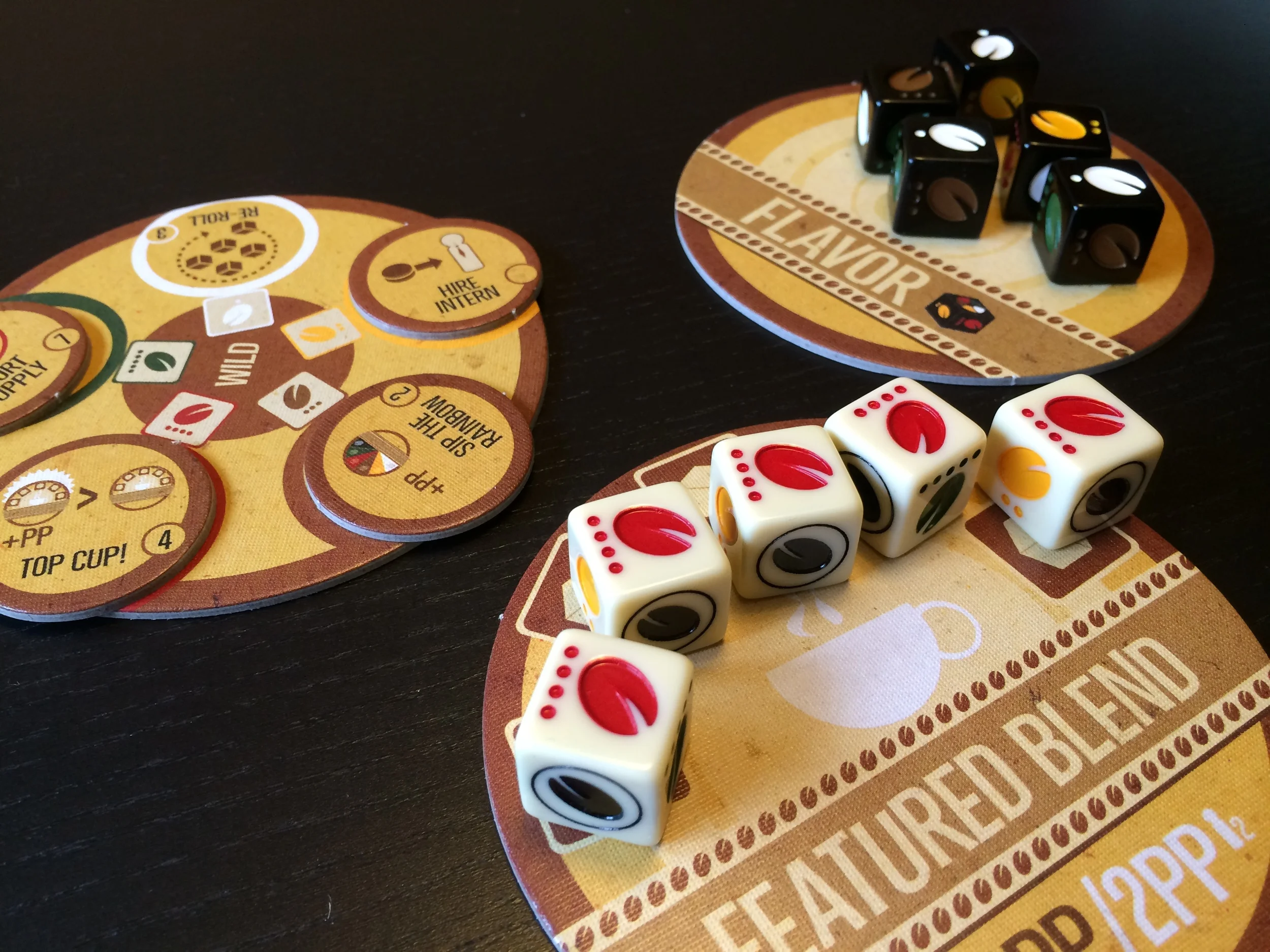
Dice manipulation is a common way of mitigating the luck inherent in rolling dice. How did you decide on the particular dice manipulation abilities in VivaJava Dice?
I’d actually disagree with this statement. Dice manipulation, aside from re-rolling, has only recently become a “thing.” Dungeon crawlers, RPGs, and some war games have implemented modifying the result with plusses and minuses, but rarely do you see dice manipulated in a direct way--other than the Yahtzee re-roll, of course. I was actually extremely surprised that someone had not created a similar system to VivaJava Dice before. After Alien Frontiers, it just seemed so obvious to do this and maybe it’s so obvious that people assume it’s out there in some form, but it just didn’t exist.
Deciding on dice manipulation abilities wasn’t really a decision. I used every single dice manipulation ability that exists. Re-roll. Flip to opposite side. Add a pip. Remove a pip. Choose any side. Dice are really limited in this sense. Anything past this point starts becoming convoluted, so if there was any real decision, it was to exclude any abilities that couldn’t be explained in about 10 words or fewer. Dice manipulation should be easily understood.
The only manipulation ability that I regret not using after the fact is “Choose another player. That player turns the die of your choice to the face of their choice.” This advanced ability would have increased player interaction and made for some interesting above-the-table moments.
What should designers keep in mind when formulating dice manipulation abilities?
I just listed all the dice manipulation abilities above. Memorize them and tweak them to your needs.
If you decide to use more complex dice manipulation than the standard re-roll, make sure each of the different faces of a die are important. Many times in VivaJava Dice, players will manipulate their dice to lower values in order to research a specific ability or to create a stronger blend. This is because each die face is significantly different and their importance varies between players and between games. If rolling higher is always better in your design, then your pool of manipulation abilities is limited even further. Most game designs have no reason to include “remove a pip” or “flip to opposite side.”
Also, know the classics. The Yahtzee re-roll is a form where players get an initial roll and then are allowed to re-roll any or all dice of their choice two more times. Be prepared for your game to be called a “Yahtzee variant.” Another classic is the Lock & Re-Roll. What this means is that a player may re-roll as many times as they want, but must lock in one or more dice with each new roll until all dice are locked. You will be compared to these.
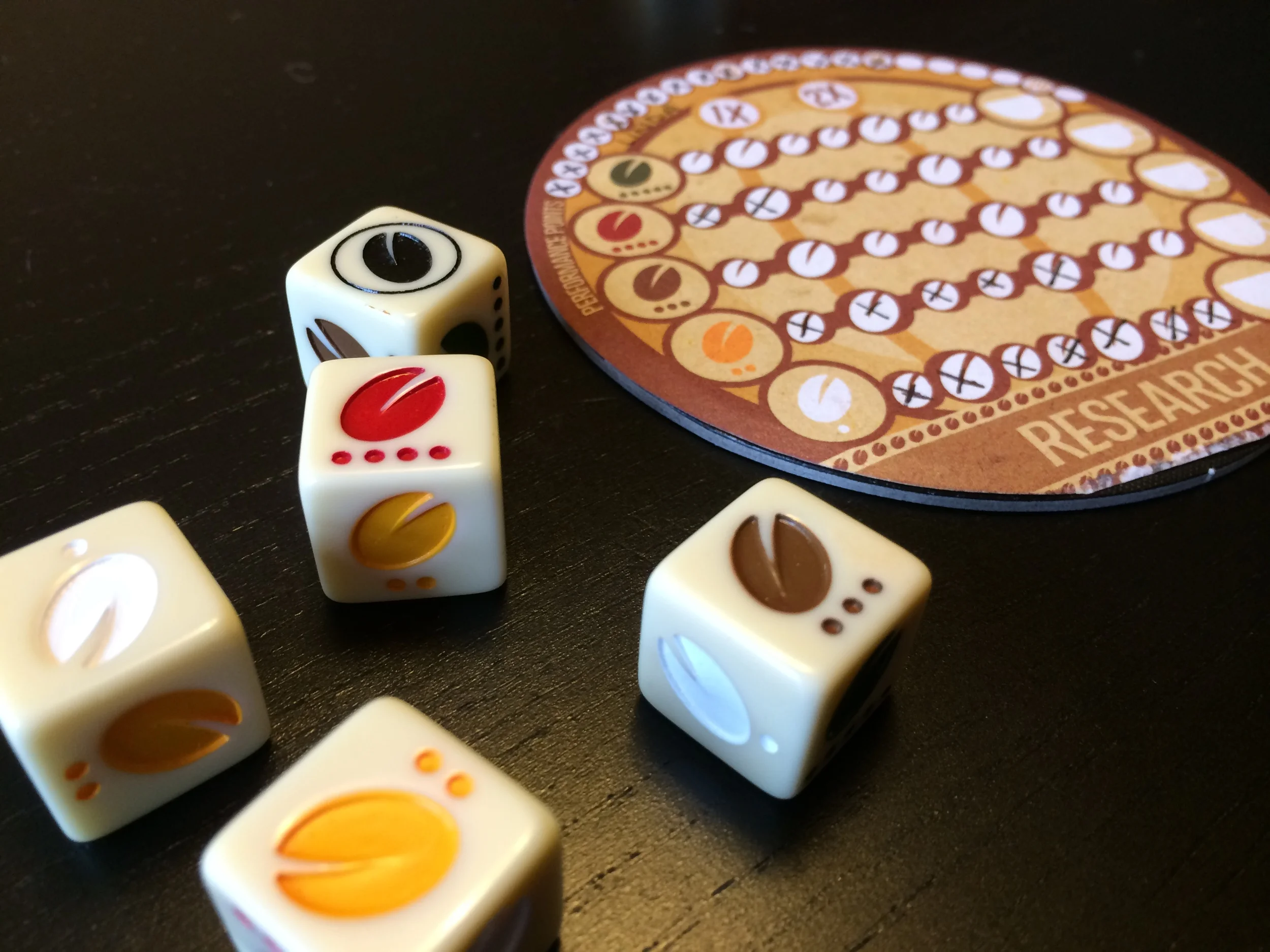
Getting a good blend means it may be in a player's best interest to sit on the blend and effectively forfeit their next turn for points rather than roll and allocate the dice. How does the design keep players participating in the game's core fun activities?
In all honesty, there are a few people that dislike this mechanic. I think these people play games way too slowly. A turn in VivaJava Dice is supposed to last somewhere around 15 seconds, otherwise I’d agree that choosing to skip your own turn for points is not a “fun” mechanic.
Players also have to degrade their Blend after scoring. Which effectively means they are making their Blend worse and more open to destruction by other players before they decide to skip their turn and hope to score more points on the next. As the game continues, this decision becomes even more crucial. The fun portion is watching other players’ turns and gritting your teeth if they come close to besting your Blend. As I mentioned before, Blends are a huge source of points, but also the most dangerous way to gain them.
Are there ways that a design can actually discourage players from having fun, and what can designers do about it?
For me, the equation is Fun equals Engagement. Even when a game is so bad that it’s entertaining, the fun is in the anticipation of the next cringe-worthy moment, or awkward butt-touching social event that will be thrust upon players. Once a player becomes bored, underwhelmed, overwhelmed, jilted, or the illusion of control is broken, the game ceases to engage the player.
The easiest way to avoid players disengaging, is to minimize downtime. The only reason a game like Through the Ages, which may have 10 to 15 minutes of downtime between turns, works, is because when it’s your turn, it’s blissfully challenging, interesting and filled with exciting mini-goals and long-term achievements. A dexterity game like PitchCar would never work if players had to wait 15 minutes for their turn. In VivaJava Dice, turns follow a simple sequence of events and are over very quickly. Roll, make a choice or two, pass the dice.
VivaJava Dice does another interesting trick though. It makes another player’s turn and actions important and, many times, exciting to watch by having an interactive element tied directly to scoring. If you play VivaJava Dice by looking only at your coaster and ignoring other players, you will lose. And the race for a point total is so immediately accessible that the metagame begins very quickly. Giving players a central goal, something to overcome or stop or avoid, keeps engagement levels higher even when players aren’t directly involved in the action.
In a dice game, avoid wasted turns or dice. If you find that your game has people stating, “Well, I can’t really do anything with this,” fix your game. And avoid random screw-over moments, either by a single die roll or by some weird randomly rolled combination that affects all players. It’s very discouraging. And make sure players get to roll their dice. It’s why people play dice games.
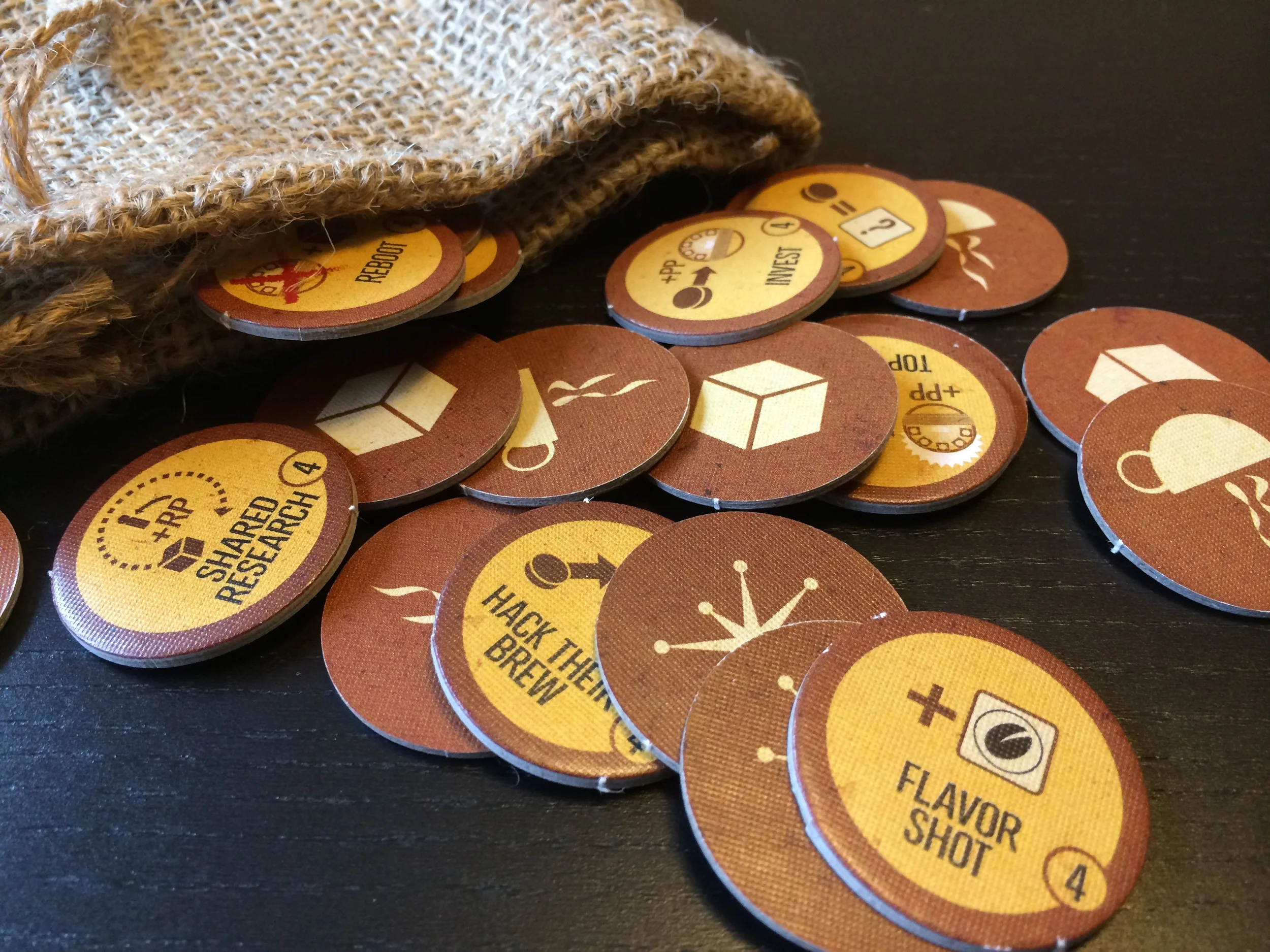
VivaJava Dice comes with a lot of research abilities that players can randomly select at the start of each game. How did you design, select and balance all of these abilities?
I’m somewhat of a perfectionist, so I have to curtail my own tendency to refine and rebalance and tweak right up until the last minute. Determining which abilities were used in the game was the most time-intensive aspect of development. It took longer than expected because of my own stubbornness.
When I released my first print-and-play for the game, I had included 18 abilities. I found out very quickly that a completely random starting setup caused problems. And most importantly, players want to roll dice in a dice game. So, no matter what the setup, I always included Re-Roll on the White bean face of the Research tracks. To make sure that every game had a balanced set of abilities, I placed each of the abilities into one of three categories, and made sure that these symbols appeared on the coaster board that allowed for customization. Players could still customize their board, but it gave a guideline to keep every game moving along.
I made some pre-designed coasters, that provided players a quick-start set of abilities that was balanced. The problem was, it was broken for new players. Scott King, a playtester and friend, told me multiple times that he could win the game consistently by spamming one of the abilities. I kept dismissing his advice until I heard another set of playtesters mention the same thing. It wasn’t until Scott visited and we played two-player that I relented. I was able to win without using the ability, but I had to employ an extremely reactive strategy. So, even though it was possible to win, it required an experienced player to do so and this was supposed to be the lightest introductory set of abilities.
The key is blind playtesting and swallowing your ego when something doesn’t work correctly. It’s an extremely difficult skill. Another playtester, Ryan Sanders (of Inquisitive Meeple), fed me ideas during the process and was instrumental in me continually questioning the final mix of abilities. Listen to people. Pick apart their brains. Sometimes they have terrible ideas, but many times they can also solve problems that you never knew existed.
I also wish Creamer, one of the most mean abilities from the Game of the Year expansion (it pretty much ruins another player’s turn at the cost of a token) was included in the main game. It creates such an interesting meta game.
What can designers do to come up with compelling game powers, choose the best mix, and balance them against each other?
Usually game powers that are simple are the most overpowered. Magic: The Gathering’s initial sets were highly chaotic due to the simplicity of the text. The key to Magic’s continued success is essentially nerfing or underpowering every single card ability so that it doesn’t do the one thing you really want it to. They’ve spent 20 years fixing the chaos of the initial sets of cards. But, if you also notice, Magic is just as stubborn and resistant to change as an amateur designer’s ego. It took 15 years for the designers to realize that specific cards were always used in certain color decks. The initial band-aid was to limit cards to only four copies in each deck. But that isn’t a solution, it’s side-stepping the issue. The thing is, if a power is always the best for a certain type of strategy, then you should always have four copies of it, and if that’s the case, the card is too powerful.
So, given that the most popular hobby game in the entire world was unable to find a good balance between cards and still struggles to temper dominant strategies, don’t expect to be perfect. But the most important thing is to be acutely aware of any powers that players always go for. If there is never a reason to diverge, swallow your ego, and figure out a solution that either increases the power’s cost, makes it appear later in the game, or increases the allure of other options. Certain abilities may emerge as better or worse than others, and that’s OK as long as they are all interesting and fair in cost or require good timing to acquire.
There’s no magic spreadsheet for abilities. It’s always going to be by feel if these abilities have text that break different portions of the game. But embrace statistics and the concept of “expected value.” If you have no mathematical skill in this area, find someone who does that can give you the expected value of a player’s investment or random outcome. Certain dice manipulation abilities are better than others. For example, the Yahtzee re-roll is actually worse percentage-wise than flipping a single die to its opposite face. It’s important to have this knowledge when making cost decisions if something is clearly better than something else.
And also, make sure that players aren’t making too many decisions that sacrifice fun for strategy. The strategy should be part of the fun, so make abilities that are both fun and strategic, and players will thank you with their hard-earned cash.
Cardboard Edison is supported by our patrons on Patreon.
SENIOR INVENTORS: Steven Cole, John du Bois, Richard Durham, Matthew O’Malley, Isaias Vallejo
JUNIOR INVENTORS: Stephen B Davies, Luis Lara, Behrooz Shahriari, Aidan Short, Jay Treat
ASSOCIATES: Robert Booth, Doug Levandowski, Aaron Lim, Nathan Miller, Marcel Perro
APPRENTICES: Kevin Brusky, Kiva Fecteau, Scott Gottreu, JR Honeycutt, Marcus Ross, Diane Sauer