






Top 6 tips for inventors on presenting a toy or game
Some unexpected pitch advice from a veteran of Fisher-Price, Tyco and Hasbro:
Tips & Resources for Board Game Designers
Top 6 tips for inventors on presenting a toy or game
Some unexpected pitch advice from a veteran of Fisher-Price, Tyco and Hasbro:
What should be on the box?
http://www.bgdf.com/node/7021
Board Game Design Forum’s September 2012 Game Design Showdown - “I Spy”
http://www.bgdf.com/node/7026
“Get the game on the table. You can tweak the rules forever, but it’s meaningless unless you print the game and play it.”
The Game Crafter’s Co-Op Design Challenge
Design an original co-op game
Deadline: Nov. 15, 2012
Prizes: Game Crafter points and store credit
http://news.thegamecrafter.com/post/30873081565/announcing-the-co-op-design-challenge
The Ludology podcast discusses the much-maligned roll-and-move mechanic, including its history and whether it has a place in modern strategy games:
http://ludology.libsyn.com/webpage/ludology-episode-39-roll-and-move
Brittania designer Lewis Pulsipher (@lewpuls) gave a wide-ranging two-hour talk at the recent World Boardgaming Championships, covering topics including:
http://pulsiphergames.com/teaching1.htm
Direct link to mp3: http://pulsiphergames.com/presentation/Lew%20Talk%20at%20WBC%202012.mp3
Every month, we round up our favorite tips and resources for aspiring board game designers to create a monthly best-of list.
Here are our picks for August 2012:
Most important cautions for novice game designers, by Lewis Pulsipher:
http://pulsiphergamedesign.blogspot.com/2012/09/seven-years-and-million-dollars.html
“HOW DO I GET A GAME PUBLISHED?” in 17 Tweets. I’m sorry, I mean “Steps.”
By John Kovalic (@muskrat_john)
STEP 1: Make a playable prototype of your game.
STEP 2: Playtest the HELL out of it. Not just with family and friends. Most importantly, with people with no vested interest in your sanity.
STEP 3: Keep playtesting it.
STEP 4: No. Seriously. KEEP PLAYTESTING THE DAMN THING, until you’re SICK of it. Then playtest some more.
STEP 5: Go to gaming conventions. Talk with people who own companies. Ask them about their submission process. Buy them beers.
STEP 6: Hey! Look! There’s some free time! Just right for some more PLAYTESTING!
STEP 7: Work on more prototypes to send to companies. Make these the best you can.
STEP 8: Unless you want to FOUND your own gaming company.
STEP 9: YOU DO NOT WANT TO FOUND YOUR OWN GAMING COMPANY!
STEP 10: Is it a day ending in “Y”? Time for more playtesting.
STEP 11: Send out your prototypes. Follow the companies’ submission guidelines TO THE LETTER.
STEP 12: No. Really. TO THE LETTER! If you can’t follow THEIR rules, why should they trust yours?
STEP 13: Be prepared for rejection. Do not let rejection break you.
STEP 14: Accept some of the criticism. It’s nothing personal. Some may be hooey, but some may do you good.
STEP 15: Do not get defensive. NO, JUST DON’T. Send out polite, professional “Thank you"s. Hope they are willing to keep in touch.
STEP 16: Send out more prototypes. Set up more playtests. Did someone say "PLAYTESTS”?
STEP 17: Repeat until you get accepted, or start working on your next game.
“Focus is the key to move from someone with a great game idea to a game designer with a great game.”
2013 Ion Award Game Design Competition
Deadline: Nov. 30, 2012
Entry fee: $10
http://boardgamegeek.com/thread/849628/2013-ion-award-game-design-competition
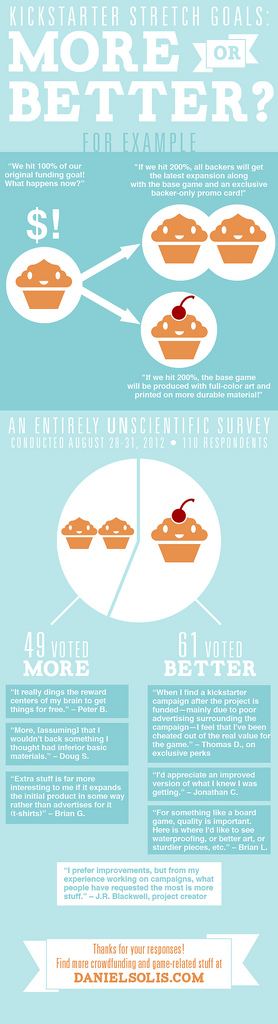
Kickstarter Stretch Goal Perks: More or Better? by Daniel Solis (@DanielSolis)
Some tips for creating a print-and-play version of your game, from the BoardGameGeek design forum:
http://boardgamegeek.com/article/9950854#9950854
SEE ALSO:
http://cardboardedison.tumblr.com/post/20879731110/miscellaneous-tips-for-creating-a-print-and-play
Demoing your game: tips from the BoardGameGeek design forum
http://boardgamegeek.com/thread/848459/demoing-a-game-looking-for-advice
Jesse Catron (@ktronod) on chrome rims on games, having a repertoire of mechanics, deck-building, the importance of focus and more:
http://bellwethergames.com/bellwether-resources/featureddesigners/192-jesse-catron-interview.html
Legal considerations for board game designers and publishers, including Kickstarter projects, registering a business, working with freelancers, trademark issues and more:
http://lawofthegeek.com/2012/08/27/lotg-23-law-for-geeks-a-gencon-panel/
Wolfgang Kramer on changes in the board game industry, originality in game design and more:
http://meepletown.com/2012/08/game-designer-interview-wolfgang-kramer/
“Many designers, myself included, have a tendency to add on this cool idea or that to the games core. Sometimes it meshes well but often it’s cumbersome and detracts from the game experience. It’s like putting a giant spoiler and spinning chrome rims on an Aston Martin; it may seem cool at the time but you are destroying a thing of beauty.”
Questions you should ask playtesters
http://boardgamegeek.com/thread/848671/playtesting-questionnaire-creation