







The Game Crafter’s Co-Op Design Challenge
Design an original co-op game
Deadline: Nov. 15, 2012
Prizes: Game Crafter points and store credit
http://news.thegamecrafter.com/post/30873081565/announcing-the-co-op-design-challenge
Tips & Resources for Board Game Designers
The Game Crafter’s Co-Op Design Challenge
Design an original co-op game
Deadline: Nov. 15, 2012
Prizes: Game Crafter points and store credit
http://news.thegamecrafter.com/post/30873081565/announcing-the-co-op-design-challenge
The Ludology podcast discusses the much-maligned roll-and-move mechanic, including its history and whether it has a place in modern strategy games:
http://ludology.libsyn.com/webpage/ludology-episode-39-roll-and-move
Brittania designer Lewis Pulsipher (@lewpuls) gave a wide-ranging two-hour talk at the recent World Boardgaming Championships, covering topics including:
http://pulsiphergames.com/teaching1.htm
Direct link to mp3: http://pulsiphergames.com/presentation/Lew%20Talk%20at%20WBC%202012.mp3
Every month, we round up our favorite tips and resources for aspiring board game designers to create a monthly best-of list.
Here are our picks for August 2012:
Most important cautions for novice game designers, by Lewis Pulsipher:
http://pulsiphergamedesign.blogspot.com/2012/09/seven-years-and-million-dollars.html
“HOW DO I GET A GAME PUBLISHED?” in 17 Tweets. I’m sorry, I mean “Steps.”
By John Kovalic (@muskrat_john)
STEP 1: Make a playable prototype of your game.
STEP 2: Playtest the HELL out of it. Not just with family and friends. Most importantly, with people with no vested interest in your sanity.
STEP 3: Keep playtesting it.
STEP 4: No. Seriously. KEEP PLAYTESTING THE DAMN THING, until you’re SICK of it. Then playtest some more.
STEP 5: Go to gaming conventions. Talk with people who own companies. Ask them about their submission process. Buy them beers.
STEP 6: Hey! Look! There’s some free time! Just right for some more PLAYTESTING!
STEP 7: Work on more prototypes to send to companies. Make these the best you can.
STEP 8: Unless you want to FOUND your own gaming company.
STEP 9: YOU DO NOT WANT TO FOUND YOUR OWN GAMING COMPANY!
STEP 10: Is it a day ending in “Y”? Time for more playtesting.
STEP 11: Send out your prototypes. Follow the companies’ submission guidelines TO THE LETTER.
STEP 12: No. Really. TO THE LETTER! If you can’t follow THEIR rules, why should they trust yours?
STEP 13: Be prepared for rejection. Do not let rejection break you.
STEP 14: Accept some of the criticism. It’s nothing personal. Some may be hooey, but some may do you good.
STEP 15: Do not get defensive. NO, JUST DON’T. Send out polite, professional “Thank you"s. Hope they are willing to keep in touch.
STEP 16: Send out more prototypes. Set up more playtests. Did someone say "PLAYTESTS”?
STEP 17: Repeat until you get accepted, or start working on your next game.
“Focus is the key to move from someone with a great game idea to a game designer with a great game.”
2013 Ion Award Game Design Competition
Deadline: Nov. 30, 2012
Entry fee: $10
http://boardgamegeek.com/thread/849628/2013-ion-award-game-design-competition
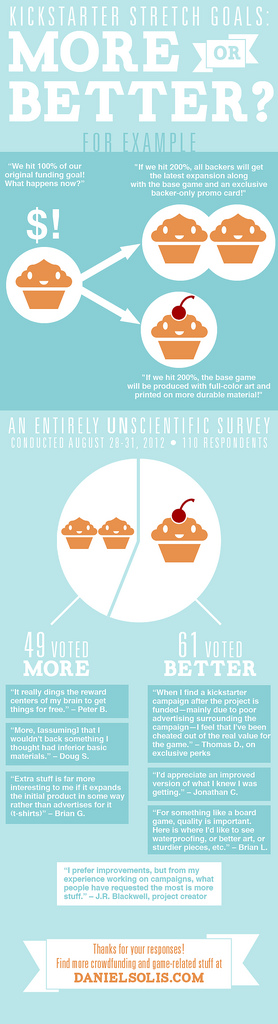
Kickstarter Stretch Goal Perks: More or Better? by Daniel Solis (@DanielSolis)
Some tips for creating a print-and-play version of your game, from the BoardGameGeek design forum:
http://boardgamegeek.com/article/9950854#9950854
SEE ALSO:
http://cardboardedison.tumblr.com/post/20879731110/miscellaneous-tips-for-creating-a-print-and-play
Demoing your game: tips from the BoardGameGeek design forum
http://boardgamegeek.com/thread/848459/demoing-a-game-looking-for-advice
Jesse Catron (@ktronod) on chrome rims on games, having a repertoire of mechanics, deck-building, the importance of focus and more:
http://bellwethergames.com/bellwether-resources/featureddesigners/192-jesse-catron-interview.html
Legal considerations for board game designers and publishers, including Kickstarter projects, registering a business, working with freelancers, trademark issues and more:
http://lawofthegeek.com/2012/08/27/lotg-23-law-for-geeks-a-gencon-panel/
Wolfgang Kramer on changes in the board game industry, originality in game design and more:
http://meepletown.com/2012/08/game-designer-interview-wolfgang-kramer/
“Many designers, myself included, have a tendency to add on this cool idea or that to the games core. Sometimes it meshes well but often it’s cumbersome and detracts from the game experience. It’s like putting a giant spoiler and spinning chrome rims on an Aston Martin; it may seem cool at the time but you are destroying a thing of beauty.”
Questions you should ask playtesters
http://boardgamegeek.com/thread/848671/playtesting-questionnaire-creation
What determines a game’s optimal length?
“If you want to go fast, work alone. If you want to go far, work with someone else.”
Friday is the deadline for The Game Crafter’s Steampunk Design Challenge:
http://news.thegamecrafter.com/post/26404680048/steampunk-design-challenge
Some principles for creating an expansion, from Scott Caputo (designer of Kachina/Völuspá):
http://boardgamegeek.com/blogpost/12929/designer-diary-voluspa-or-how-a-native-american-su
SEE ALSO:
Lessons learned designing an expansion, by Grant Rodiek (@HerrohGrant):
http://cardboardedison.tumblr.com/post/19177839103/lessons-learned-designing-an-expansion-by