









“Praise doesn’t help me make my game better, it only serves to reassure me that I make awesome decisions and that hampers my ability to change those decisions later.”
Playtesting: For how long, and how much input do you incorporate?
A BoardGameGeek forum:
http://boardgamegeek.com/thread/808606/playtesting-for-how-long-and-how-much-input-do-you
Getting your board game reviewed. Two posts:
http://boardgamegeek.com/thread/808503/getting-your-game-reviewed
“I think the methods and tricks for designing a card or board game are very similar to those used by novel writers, the main difference being that we game designers skip the hardest part: the actual writing.”
What elements of a game can be legally protected?
The Law of the Geek podcast tackles the subject:
http://lawofthegeek.com/2012/05/21/lotg-episode-16-warning-system-failure/
Max Osterhaus, director of product development for Out of the Box Publishing, shares his tips for inventing, submitting and publishing successful games:
http://www.otb-games.com/?p=2562
Pointers for creating good rules–and for writing them–from Jay Treat (@jtreat3):
http://hyperbolegames.com/2012/05/25/make-good-rules/
The Game Design Graveyard
Share your shelved game ideas and pay respect to others’
http://boardgamegeek.com/thread/807668/the-game-design-graveyard
“I sometimes think of games as cars: they need to have an engine (the core mechanic), a steering wheel, gear shift and gas pedal (ways for the players to set their speed and direction), and the car body (flavor and theme). Also, if possible, a destination. The perfect game like a great car has all the parts fitting well together, and that’s what hopefully we are all trying to achieve.”
The Strategy Game Designer’s Constitution contains some “golden rules” for design, considerations for giving games strategic depth, plus a good list of potential end-game and victory conditions:
http://www.leiavoia.net/pages/docs/Strategy_Game_Designers_Constitution.pdf
Here’s the handy, pocket-sized Strategy Game Designer’s Cheatsheet:
http://www.leiavoia.net/pages/docs/Strategy_Game_Designers_Cheatsheet.pdf
“Scoring simply as performance evaluation or identifying winners is not interesting. You have to actually care about the game for winning to be meaningful so if you’re going to score, the way you do it has to validate the game experience. How it’s done matters a lot.”
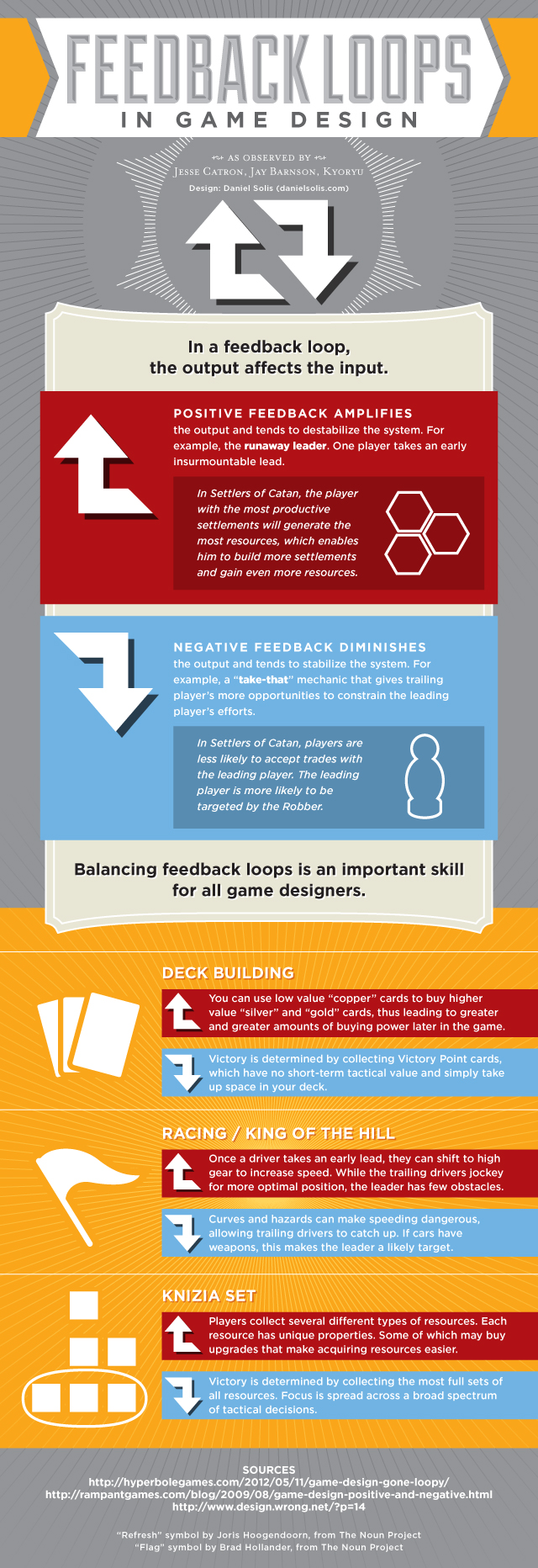
Tips for designing sports-themed tabletop games:
http://spoiledflushgames.com/playing-card-basketball-designers-diary/
When should you submit your game to BoardGameGeek? Check their Guide to Submissions:
http://www.boardgamegeek.com/wiki/page/BGG_Guide_to_Game_Submissions
And this additional explanation: