







Having a hit game can pose some surprising challenges for a publisher—here are some ways of handling a runaway success:
https://stonemaiergames.com/the-next-big-thing-how-to-handle-a-products-runaway-success/
Tips & Resources for Board Game Designers
Having a hit game can pose some surprising challenges for a publisher—here are some ways of handling a runaway success:
https://stonemaiergames.com/the-next-big-thing-how-to-handle-a-products-runaway-success/
Money in board games: modeling inflation, different components for money, loans in games, money that isn’t money, games without money, money as the theme, and more (scroll for English):
https://faidutti.com/blog/blog/2023/09/25/les-jeux-et-largent-money-and-games/
Balance: a deep, two-part discussion about what game balance is, why we care about it, how games can be balanced, and the downsides of overbalancing a design (audio):
https://decisionspace.podbean.com/e/balance-pt-1-what-we-talk-about/
https://decisionspace.podbean.com/e/balance-pt-2-what-we-talk-about/
The board game designer’s oath: some best practices for doing right by your playtesters and fellow designers (video):
Some reasons why players may find your game’s theme “boring”:
https://shippboardgames.blogspot.com/2023/09/boring-themes.html
How to receive feedback on your game and handle tricky situations with playtesters without stressing out about it too much (video):
Starting the process of signing a game with a publisher—some tips for breaking in as a newcomer:
“Keep in mind that every game you create (or try to create) is a learning experience. Know that discarded games are not useless. You will always learn from a failed game. These are the ones that teach you the most. A shelved game is like negative feedback well given, you learn much more than with positive feedback.”
How to make a budget for a crowdfunding project—with a downloadable spreadsheet to help crunch the numbers (video):
Why board game designers should always insist on getting an advance as part of a licensing contract:
Thoughts on best practices for crafting a board game’s pacing, core activity, strategy, and endgame—and how they’re all related:
https://twitter.com/chessandpoker/status/1700210477458923981
How to get a game on Board Game Arena:
https://prometheusgamelabs.wordpress.com/2023/08/14/how-a-game-gets-on-board-game-arena/
Using overlapping turns to reduce player downtime—and some pitfalls of doing so:
Apiary designer Connie Vogelmann shares seven game design lessons learned working on the game:
https://stonemaiergames.com/7-lessons-learned-designing-apiary-by-connie-vogelmann/
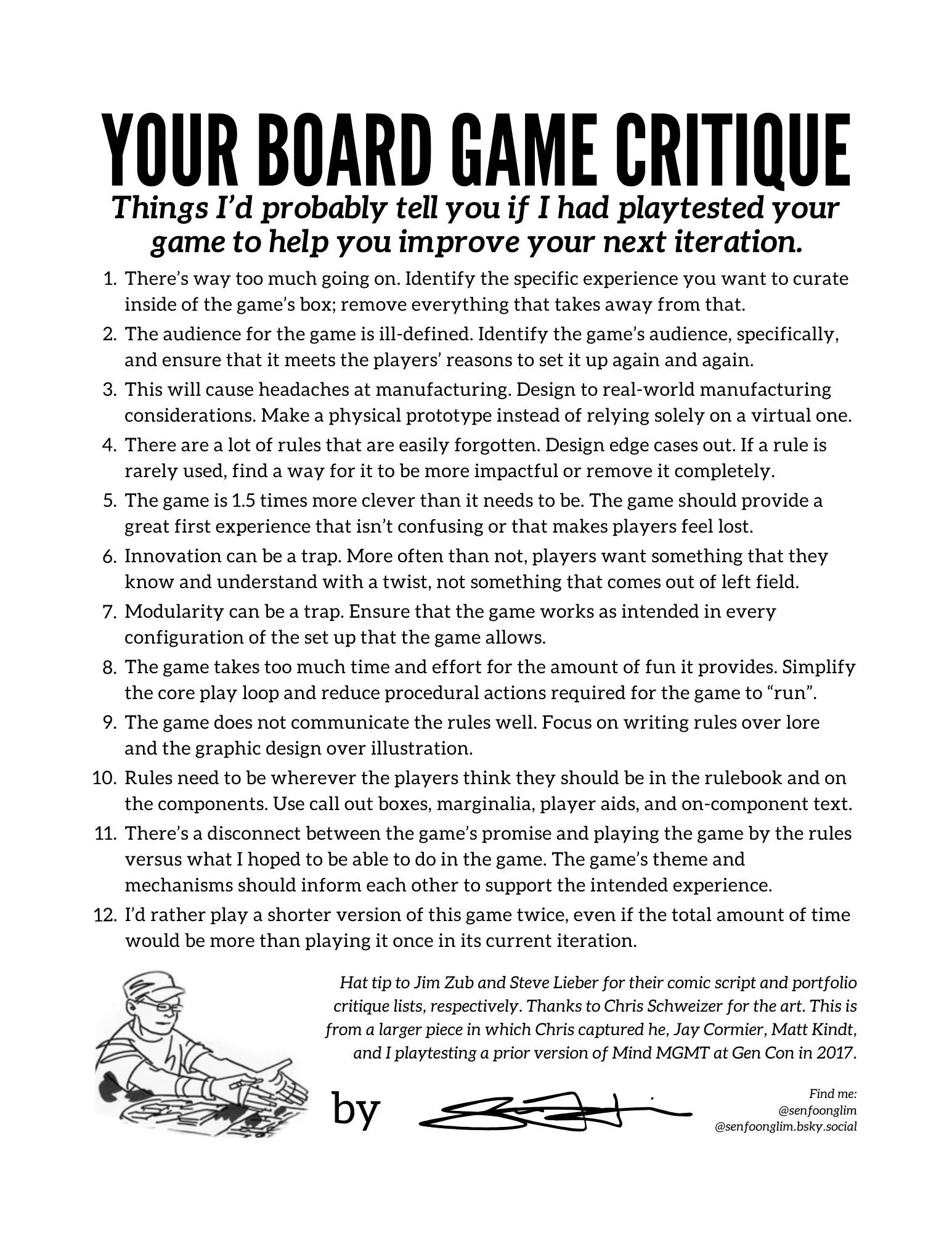
12 questions to help identify the next step in development for your tabletop game, or to help you get a wayward design back on track:
https://docs.google.com/document/d/1utzo5NWTfT0ov-JGXSujLocgU_9iM4Jop6t7i-FjYA4/edit
via @npcaaron
How to make game mechanics feel more thematic:
https://shippboardgames.blogspot.com/2023/09/thematic-feeling-mechanisms.html
Digital prototyping tools: board game designers share their favorites:
https://bsky.app/profile/peterlmcpherson.bsky.social/post/3k6bbaflhgn2x
Pitching your board game to a publisher for the first time: tips from the design community:
Intelligent cardboard: a history of different approaches to creating AI systems for tabletop games (video):