








Meaningful Decisions: T.C. Petty III on Design Choices in VivaJava Dice
/In our Meaningful Decisions series, we ask designers about the design choices they made while creating their games, and what lessons other designers can take away from those decisions.
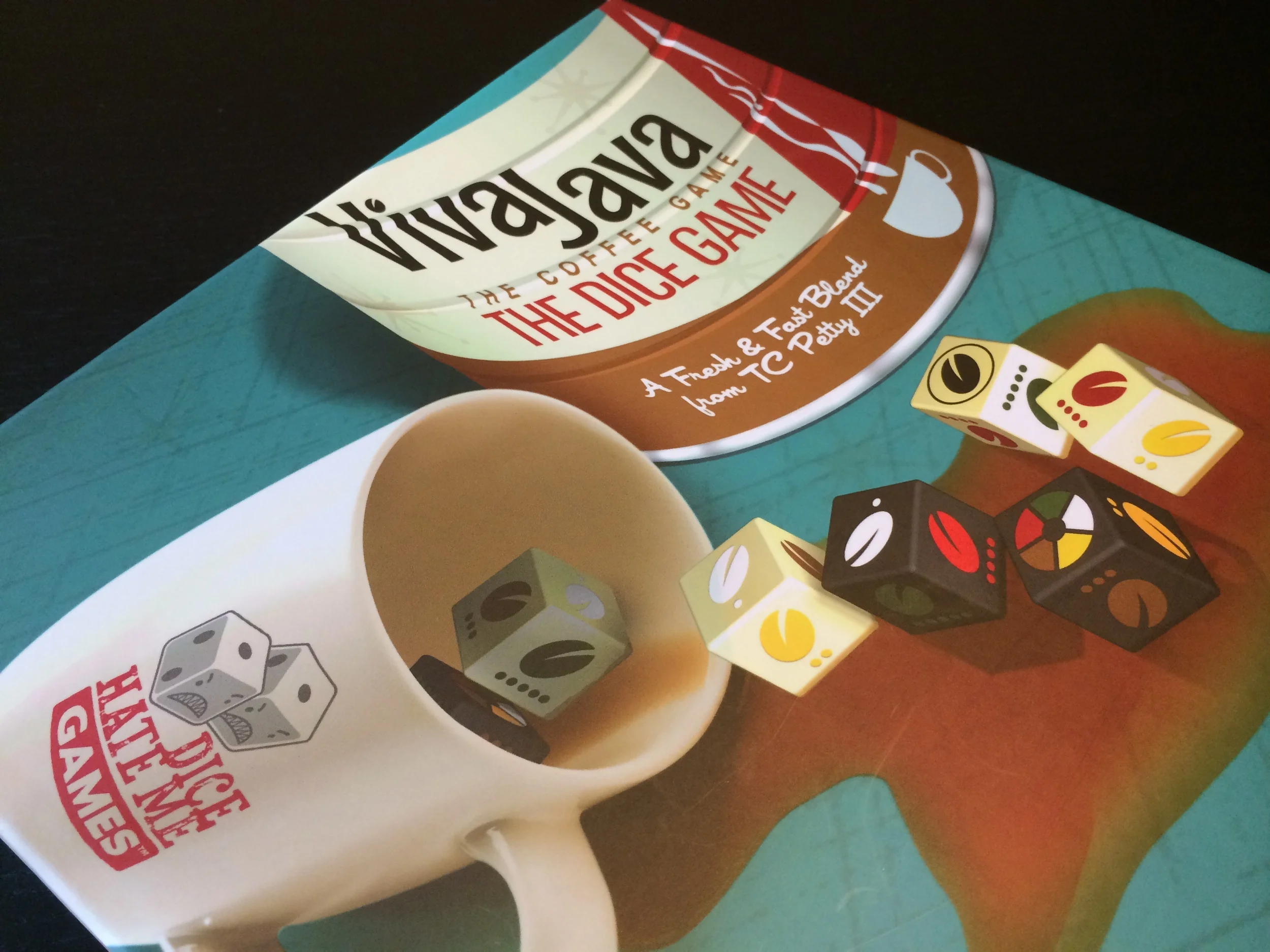
In this edition, we talk with T.C. Petty III, the designer of VivaJava: The Coffee Game: The Dice Game, about balancing different strategies, dice manipulation, player engagement, variable abilities and more.

Players in VivaJava Dice will advance on one of two tracks each turn: performance points, which bring them closer to victory, or research points, which let them build a game engine to score more performance points. How did you settle on this dual-track framework and balance both approaches?
The key to making VivaJava Dice feel balanced even when there is this weird and major randomization agent called dice is to balance the ways to score points.
I wanted players to have an obvious and easy way to score points: make coffee blends. But, I also wanted a way for players to build their own engine with little interference from other players: Research. What makes the game an unsolvable, interactive puzzle is that your choices can impact other players’ choices on a tactical level.
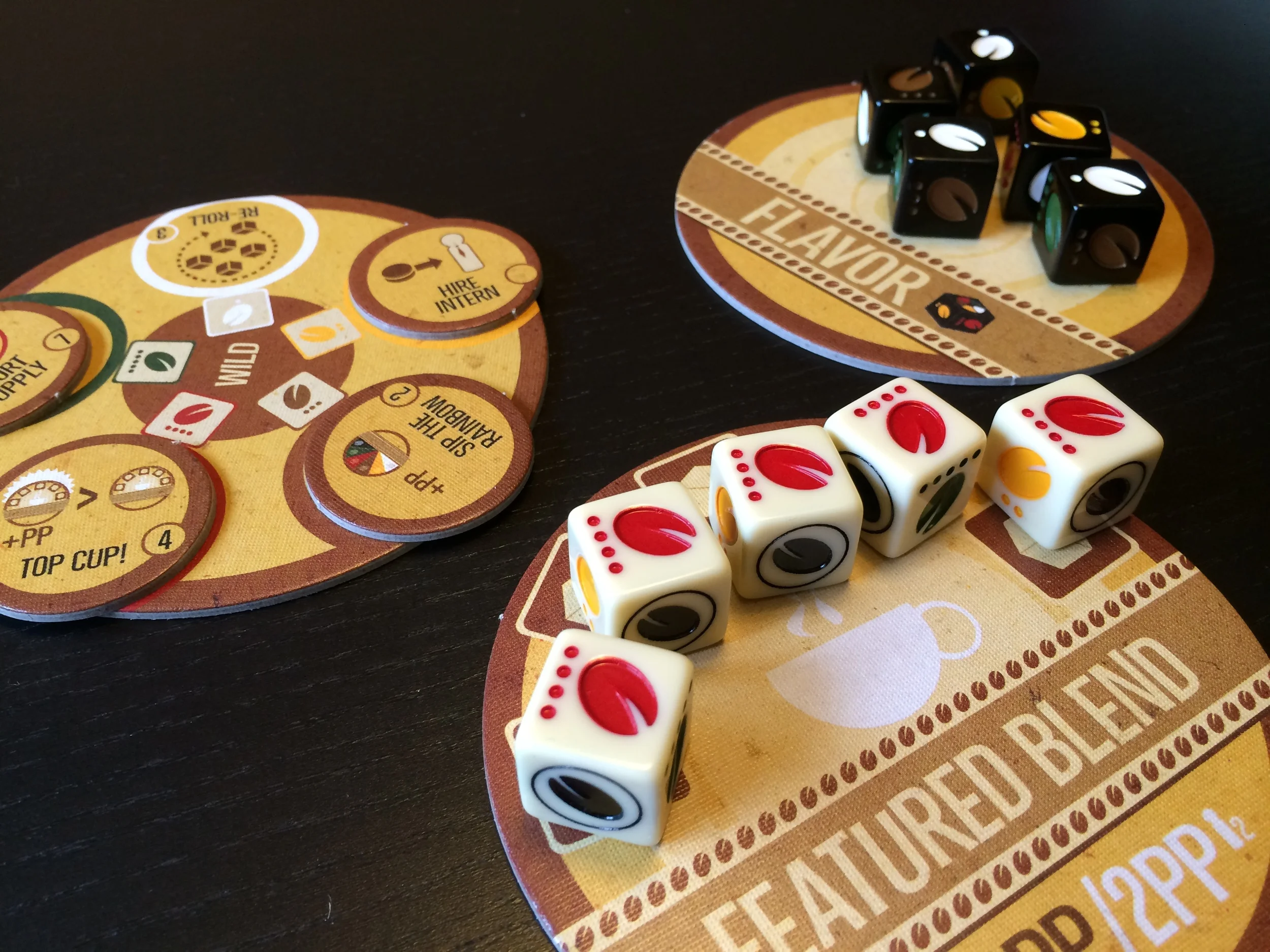
By making the most obvious way to score also the most vulnerable to player interaction, it provides an interesting short-term goal. Enter the king-of-the-hill mechanic. Players can create a Featured Blend with their coffee dice to score major points, but if another player is able to make a better Featured Blend, they can replace your Blend before those points can be locked in at the start of your next turn. Also, to make sure that the decision matters on either side, when a player decides to risk their Featured Blend, they lose their ability to Research. So, while an aggressive player may be scoring points, they cannot invest in abilities. I also added a second Blend called the Rainbow Blend which is even more volatile, but allows the player to both score points and take Research.
Research not only gives players new abilities, but it allows them to score points as well by reaching the end of these tracks. However, to balance this out, I made it so that once scored, you lose the ability listed on the Research track. Suddenly, tactical timing also becomes important.
Blending represents short-term goals that can be scored multiple times, while Research represents long-term investments that can be cashed in for short-term rewards. This mix of tactics and strategy and luck makes for some satisfying easy decisions and some crucial agonizing decisions.
How can designers ensure that their game accommodates the two playstyles of going for points versus engine-building?
I’d actually recommend that designers play Saint Petersburg. Like, really sit down and play Saint Petersburg about 15 times. It’s a fantastic game, and the engine-building in it is possibly the simplest and most satisfying. But it’s really strict and unbalanced. And that imbalance is only apparent after many, many entertaining plays. Experienced players will absolutely destroy new players. However, it taught me several huge lessons in game design and how to improve upon games of the past. “Nobles.” That’s all I’m saying.
Don’t just break out a spreadsheet. Make sure that player interaction is your balancing mechanism. Juicy points should exist in a fragile space, require excellent timing, or have a negative effect. Investment should be rewarded, but if it exists within a personal space isolated from other players, it should never trump the interactive points (unless players allow it to).
I’ve always been a fan of victory points. I know it sounds ridiculous, but when you play a lot of “classic” games, you start to notice that games either end at a finish line or by most cash. The stuff you do during the game doesn’t convert to victory points and it usually funnels your strategy down one specific path. Being able to convert “things” into points in various ways is what creates interesting decisions and multiple paths to victory.
Dice manipulation is a common way of mitigating the luck inherent in rolling dice. How did you decide on the particular dice manipulation abilities in VivaJava Dice?
I’d actually disagree with this statement. Dice manipulation, aside from re-rolling, has only recently become a “thing.” Dungeon crawlers, RPGs, and some war games have implemented modifying the result with plusses and minuses, but rarely do you see dice manipulated in a direct way--other than the Yahtzee re-roll, of course. I was actually extremely surprised that someone had not created a similar system to VivaJava Dice before. After Alien Frontiers, it just seemed so obvious to do this and maybe it’s so obvious that people assume it’s out there in some form, but it just didn’t exist.
Deciding on dice manipulation abilities wasn’t really a decision. I used every single dice manipulation ability that exists. Re-roll. Flip to opposite side. Add a pip. Remove a pip. Choose any side. Dice are really limited in this sense. Anything past this point starts becoming convoluted, so if there was any real decision, it was to exclude any abilities that couldn’t be explained in about 10 words or fewer. Dice manipulation should be easily understood.
The only manipulation ability that I regret not using after the fact is “Choose another player. That player turns the die of your choice to the face of their choice.” This advanced ability would have increased player interaction and made for some interesting above-the-table moments.
What should designers keep in mind when formulating dice manipulation abilities?
I just listed all the dice manipulation abilities above. Memorize them and tweak them to your needs.
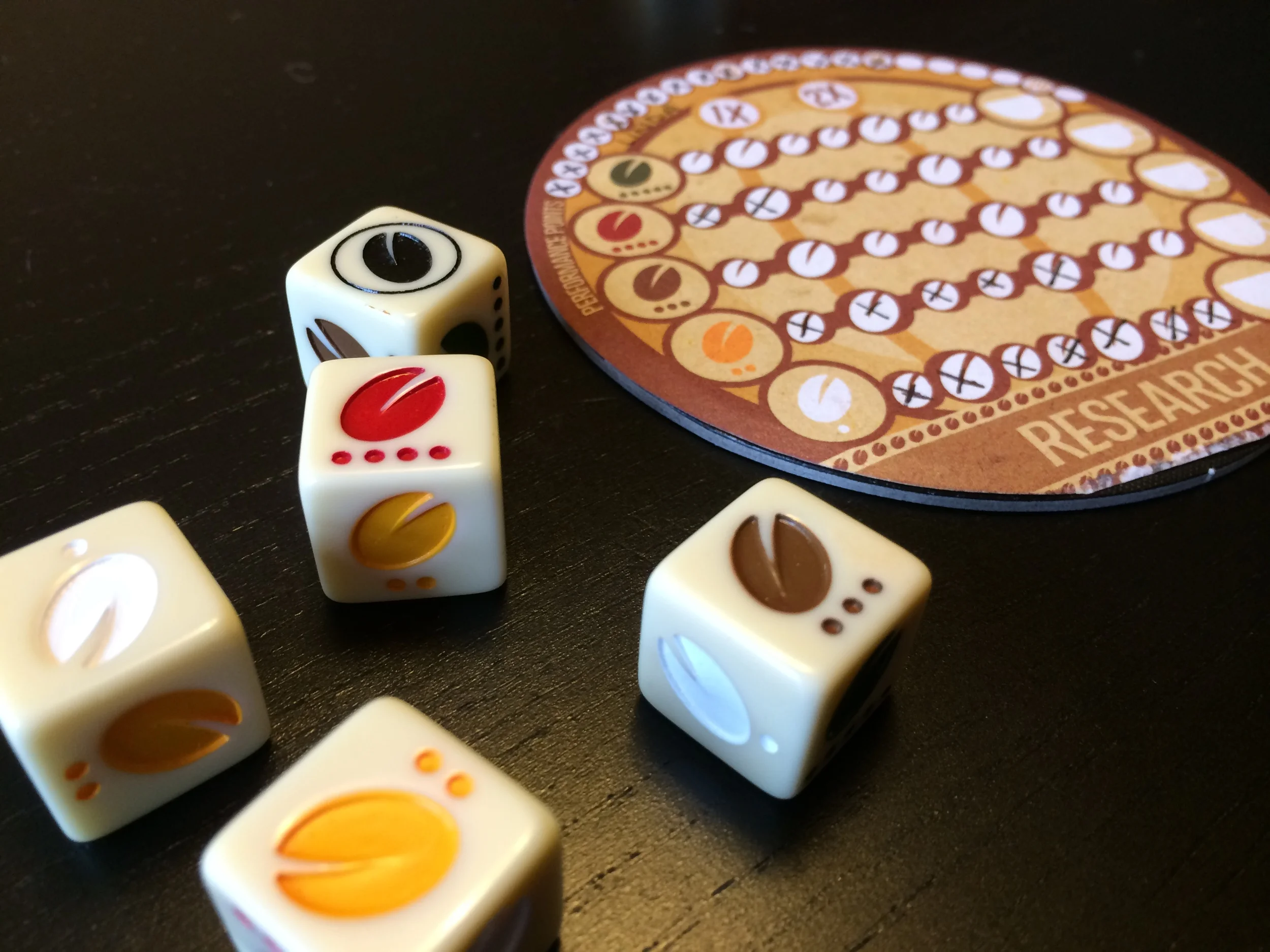
If you decide to use more complex dice manipulation than the standard re-roll, make sure each of the different faces of a die are important. Many times in VivaJava Dice, players will manipulate their dice to lower values in order to research a specific ability or to create a stronger blend. This is because each die face is significantly different and their importance varies between players and between games. If rolling higher is always better in your design, then your pool of manipulation abilities is limited even further. Most game designs have no reason to include “remove a pip” or “flip to opposite side.”
Also, know the classics. The Yahtzee re-roll is a form where players get an initial roll and then are allowed to re-roll any or all dice of their choice two more times. Be prepared for your game to be called a “Yahtzee variant.” Another classic is the Lock & Re-Roll. What this means is that a player may re-roll as many times as they want, but must lock in one or more dice with each new roll until all dice are locked. You will be compared to these.
Getting a good blend means it may be in a player's best interest to sit on the blend and effectively forfeit their next turn for points rather than roll and allocate the dice. How does the design keep players participating in the game's core fun activities?
In all honesty, there are a few people that dislike this mechanic. I think these people play games way too slowly. A turn in VivaJava Dice is supposed to last somewhere around 15 seconds, otherwise I’d agree that choosing to skip your own turn for points is not a “fun” mechanic.
Players also have to degrade their Blend after scoring. Which effectively means they are making their Blend worse and more open to destruction by other players before they decide to skip their turn and hope to score more points on the next. As the game continues, this decision becomes even more crucial. The fun portion is watching other players’ turns and gritting your teeth if they come close to besting your Blend. As I mentioned before, Blends are a huge source of points, but also the most dangerous way to gain them.
Are there ways that a design can actually discourage players from having fun, and what can designers do about it?
For me, the equation is Fun equals Engagement. Even when a game is so bad that it’s entertaining, the fun is in the anticipation of the next cringe-worthy moment, or awkward butt-touching social event that will be thrust upon players. Once a player becomes bored, underwhelmed, overwhelmed, jilted, or the illusion of control is broken, the game ceases to engage the player.
The easiest way to avoid players disengaging, is to minimize downtime. The only reason a game like Through the Ages, which may have 10 to 15 minutes of downtime between turns, works, is because when it’s your turn, it’s blissfully challenging, interesting and filled with exciting mini-goals and long-term achievements. A dexterity game like PitchCar would never work if players had to wait 15 minutes for their turn. In VivaJava Dice, turns follow a simple sequence of events and are over very quickly. Roll, make a choice or two, pass the dice.
VivaJava Dice does another interesting trick though. It makes another player’s turn and actions important and, many times, exciting to watch by having an interactive element tied directly to scoring. If you play VivaJava Dice by looking only at your coaster and ignoring other players, you will lose. And the race for a point total is so immediately accessible that the metagame begins very quickly. Giving players a central goal, something to overcome or stop or avoid, keeps engagement levels higher even when players aren’t directly involved in the action.
In a dice game, avoid wasted turns or dice. If you find that your game has people stating, “Well, I can’t really do anything with this,” fix your game. And avoid random screw-over moments, either by a single die roll or by some weird randomly rolled combination that affects all players. It’s very discouraging. And make sure players get to roll their dice. It’s why people play dice games.
VivaJava Dice comes with a lot of research abilities that players can randomly select at the start of each game. How did you design, select and balance all of these abilities?
I’m somewhat of a perfectionist, so I have to curtail my own tendency to refine and rebalance and tweak right up until the last minute. Determining which abilities were used in the game was the most time-intensive aspect of development. It took longer than expected because of my own stubbornness.
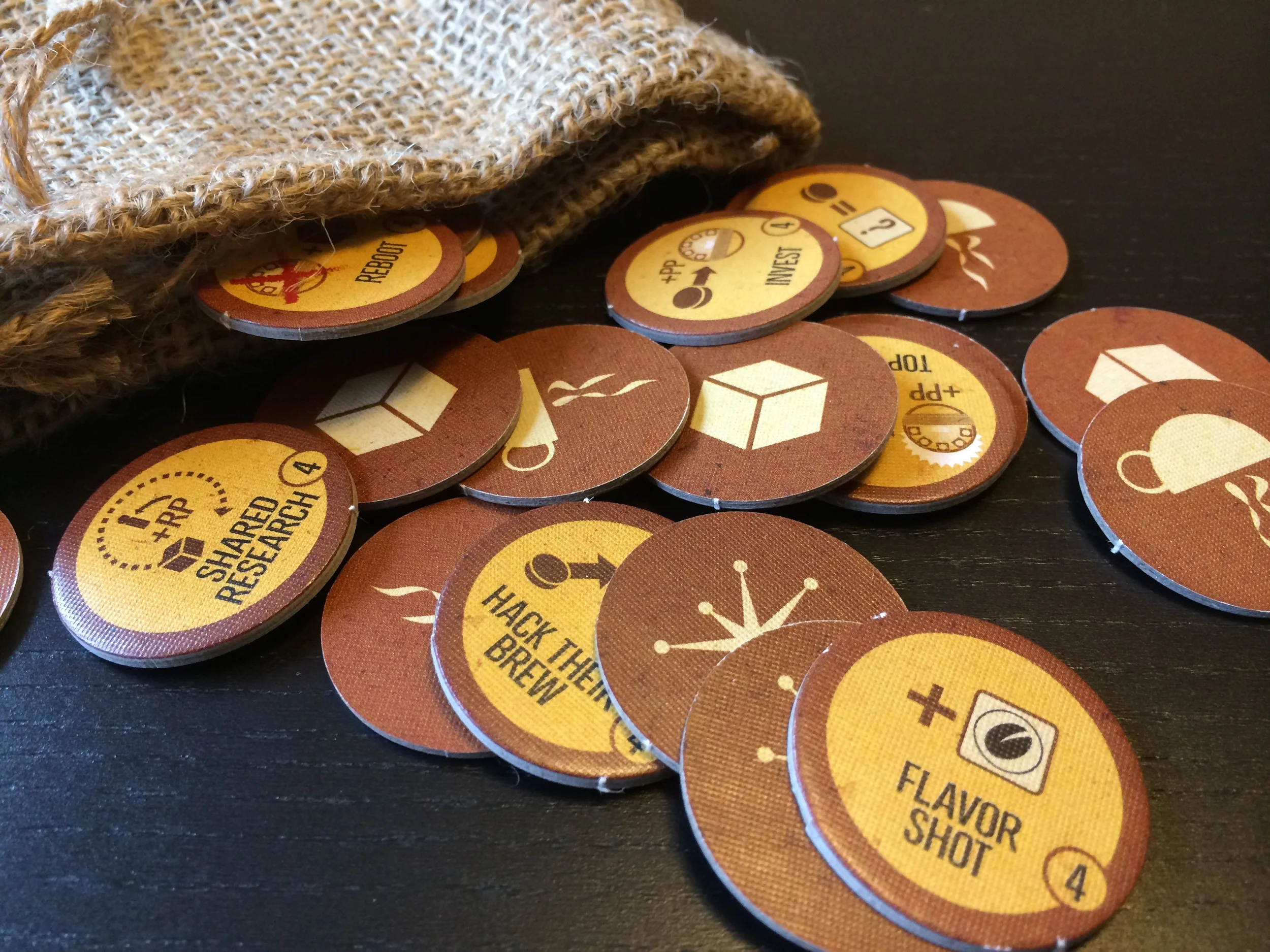
When I released my first print-and-play for the game, I had included 18 abilities. I found out very quickly that a completely random starting setup caused problems. And most importantly, players want to roll dice in a dice game. So, no matter what the setup, I always included Re-Roll on the White bean face of the Research tracks. To make sure that every game had a balanced set of abilities, I placed each of the abilities into one of three categories, and made sure that these symbols appeared on the coaster board that allowed for customization. Players could still customize their board, but it gave a guideline to keep every game moving along.
I made some pre-designed coasters, that provided players a quick-start set of abilities that was balanced. The problem was, it was broken for new players. Scott King, a playtester and friend, told me multiple times that he could win the game consistently by spamming one of the abilities. I kept dismissing his advice until I heard another set of playtesters mention the same thing. It wasn’t until Scott visited and we played two-player that I relented. I was able to win without using the ability, but I had to employ an extremely reactive strategy. So, even though it was possible to win, it required an experienced player to do so and this was supposed to be the lightest introductory set of abilities.
The key is blind playtesting and swallowing your ego when something doesn’t work correctly. It’s an extremely difficult skill. Another playtester, Ryan Sanders (of Inquisitive Meeple), fed me ideas during the process and was instrumental in me continually questioning the final mix of abilities. Listen to people. Pick apart their brains. Sometimes they have terrible ideas, but many times they can also solve problems that you never knew existed.
I also wish Creamer, one of the most mean abilities from the Game of the Year expansion (it pretty much ruins another player’s turn at the cost of a token) was included in the main game. It creates such an interesting meta game.
What can designers do to come up with compelling game powers, choose the best mix, and balance them against each other?
Usually game powers that are simple are the most overpowered. Magic: The Gathering’s initial sets were highly chaotic due to the simplicity of the text. The key to Magic’s continued success is essentially nerfing or underpowering every single card ability so that it doesn’t do the one thing you really want it to. They’ve spent 20 years fixing the chaos of the initial sets of cards. But, if you also notice, Magic is just as stubborn and resistant to change as an amateur designer’s ego. It took 15 years for the designers to realize that specific cards were always used in certain color decks. The initial band-aid was to limit cards to only four copies in each deck. But that isn’t a solution, it’s side-stepping the issue. The thing is, if a power is always the best for a certain type of strategy, then you should always have four copies of it, and if that’s the case, the card is too powerful.
So, given that the most popular hobby game in the entire world was unable to find a good balance between cards and still struggles to temper dominant strategies, don’t expect to be perfect. But the most important thing is to be acutely aware of any powers that players always go for. If there is never a reason to diverge, swallow your ego, and figure out a solution that either increases the power’s cost, makes it appear later in the game, or increases the allure of other options. Certain abilities may emerge as better or worse than others, and that’s OK as long as they are all interesting and fair in cost or require good timing to acquire.
There’s no magic spreadsheet for abilities. It’s always going to be by feel if these abilities have text that break different portions of the game. But embrace statistics and the concept of “expected value.” If you have no mathematical skill in this area, find someone who does that can give you the expected value of a player’s investment or random outcome. Certain dice manipulation abilities are better than others. For example, the Yahtzee re-roll is actually worse percentage-wise than flipping a single die to its opposite face. It’s important to have this knowledge when making cost decisions if something is clearly better than something else.
And also, make sure that players aren’t making too many decisions that sacrifice fun for strategy. The strategy should be part of the fun, so make abilities that are both fun and strategic, and players will thank you with their hard-earned cash.
Cardboard Edison is supported by our patrons on Patreon.
SENIOR INVENTORS: Steven Cole, John du Bois, Richard Durham, Matthew O’Malley, Isaias Vallejo
JUNIOR INVENTORS: Stephen B Davies, Luis Lara, Behrooz Shahriari, Aidan Short, Jay Treat
ASSOCIATES: Robert Booth, Doug Levandowski, Aaron Lim, Nathan Miller, Marcel Perro
APPRENTICES: Kevin Brusky, Kiva Fecteau, Scott Gottreu, JR Honeycutt, Marcus Ross, Diane Sauer