







Considerations when choosing a manufacturer:
https://happyottergames.wordpress.com/2015/06/23/printing-your-game-overseas/
Tips & Resources for Board Game Designers
Considerations when choosing a manufacturer:
https://happyottergames.wordpress.com/2015/06/23/printing-your-game-overseas/
Adam P. McIver (@ad7m) on working with a graphic designer, the priorities of graphic design for games and more:
http://hyperbolegames.com/2015/06/23/interview-with-adam-mciver/
In our Meaningful Decisions series, we ask designers about the design choices they made while creating their games, and what lessons other designers can take away from those decisions.
In this edition, we talk with Daniel Solis, the designer of Belle of the Ball, about drafting games, character creation, humor in games and more.

Photo by Hayley Helmstedtler
The core mechanism in Belle of the Ball features two columns of cards from which players can draft. Was the two-column draft always a feature, or were there previous versions you can tell us about?
The first version of the game mixed all of the cards together in a single deck, meaning that sometimes you had to decide whether to take a special action (from a Belle card) or start building up your party (from a Guest card).
Sometimes you’d hit streaks where the whole line was all guest cards or all Belle cards. It also meant that our currency (Regrets) would often get clogged up with a single hoarder. Later in development with Dice Hate Me, we decided to split the lines.
This divided up the Regrets a bit so they were more liquid. It also meant what was an occasional decision between Action or Set Collection now occurred *all* the time.
What tips can you share with designers who want to create a compelling drafting mechanism?
Drafting is just one way of acquiring cards. It could just as easily be a random deal to each player. The heart of a drafting game is giving players reasons to prefer one card over another. That’s the minimum standard. Ideally, you give them reasons to want to keep *all* the cards available.
Set Collection is the most common method of making drafting a compelling decision. You see it in 7 Wonders, Sushi Go, and in Belle of the Ball. However, I like it when there is a whole other layer of decision-making *after* you’ve selected your card.
Look at games like:
Finding the reason to draft X, Y, or Z is what makes a drafting mechanism interesting.
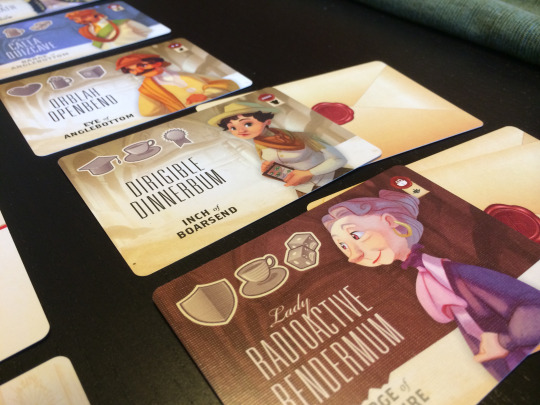
Belle of the Ball features a wide range of characters representing various colors, genders and body types. How and why did you ensure this would be the case?
You can actually download the art direction document I sent to Jacqui Davis.
We have a LOT of unique guest characters in Belle of the Ball, which to me meant there was no excuse to have a homogenous appearance for the whole cast. It would just be so bland! Also it helps for gameplay to be able to quickly and easily distinguish one guest from another.
I knew Jacqui Davis was particularly skilled at creating unique silhouettes, which is why I really wanted her for the job. I wanted a wide spectrum of ethnic diversity and gender expression, from stern Victorian aristocrats to colorful artistic bohemians. Jacqui could draw it all and fast.
What are the benefits of including diverse characters, and what are the drawbacks?
The benefits are numerous. Everyone who plays the game has their own favorite character. The marketing has no shortage of funny-looking characters to show off in publicity material. And we don’t run into the representation-problem that unfortunately is too common in board game art.
The only drawback is that we needed a suitable art budget for the job. It’s a big investment, but well worth it in the end.
Should designers have these aspects of their games’ characters in mind throughout the process, or is it primarily a consideration once the game is nearing publication?
It depends on your relationship with your publisher. Early on, I had publishers who really wanted to change the theme of Belle to something else. That would mean all these characters never would have even been created.
For any designer, I advise that they focus on the game’s design foremost. If the theme is really that important to the designer, the mechanics should be fundamentally and inextricably tied to that theme. So tightly, that decoupling them would pretty much make it a different game entirely.

Belle of the Ball brings out a lot of laughter from players, both through the silly names and titles of its characters and through surprising and clever uses of the Belle cards. How did you work humor into the game?
Humor in games is tricky. Belle is a funny game, but it isn’t a COMEDY game. Comedy games really try hard to make you laugh, but that’s really not sustainable. After the first time you see a joke on a card, the humor fades fast.
So I first acknowledged that any humor I inject into the game myself would have a short shelf life. I knew that I could get a chuckle by making players announce some tongue-twister names. Individually they’re amusing, but get funnier in rapid succession, like Eddie Izzard’s Englebert Humperdinck routine or Key & Peele’s East/West Football sketch.
Because it’s unlikely for the same player to take the same guest in multiple games, that extends the humor just a bit. You get to watch some other chump stumble over Capable Canklerack or Fffffff Flippinbird.
But aside from that, the game isn’t really trying too hard to force a laugh. It just allows players to make funny choices and express a touch of exaggerated regality. It’s not really trying too hard for the joke, you know?
Is there a difference between humor derived from flavor text and artwork, and humor that emerges from gameplay? What can designers do if they want the focus to be on one or the other?
Ack. I think I answered this question above. Sorry about that!
Well first of all, writing comedy is HARD. I used to work in advertising with some very funny people and that takes WORK. Then you tack on the job of designing a game around that? No way, that ain’t the job for me.
So my advice to designers is to focus on the game and collaborate with someone skilled at comedy writing to handle that kind of flavor text.
Cardboard Edison is supported by our patrons on Patreon.
SENIOR INVENTORS: Steven Cole, John du Bois, Richard Durham, Matthew O’Malley, Isaias Vallejo
JUNIOR INVENTORS: Stephen B Davies, Luis Lara, Behrooz Shahriari, Aidan Short, Jay Treat
ASSOCIATES: Robert Booth, Zachery Cook, Doug Levandowski, Nathan Miller, Marcel Perro
APPRENTICES: Gino Brancazio, Keith Burgun, Kiva Fecteau, Scott Gottreu, JR Honeycutt, Brad Price
An important piece of advice before signing a publishing contract:
Learn by example: lots of samples of board game sell sheets:
http://www.leagueofgamemakers.com/sell-sheets-for-game-designers-101/
An overview of the process of breaking into game design:
http://www.chaospublishing.com/2015/06/18/ep-4-becoming-a-game-designer-w-oliver-brooks/
How to speed up gameplay–a Card & Board Game Designers Guild discussion:
https://www.facebook.com/groups/GameDesignersGuild/permalink/647969218637160/
10 time-saving tips for tabletop publishers:
http://meeplemechanic.com/specials/top-10-time-saving-tips-for-tabletop-publishers/
Indie publishers discuss various aspects of publishing: manufacturing, art, Kickstarter and more:
http://theforbiddenlimb.libsyn.com/wondercon-panel-on-indie-publishing
How do I know when my game is done? The Game Crafter podcast answers:
http://thegamecrafter.libsyn.com/how-do-i-know-my-game-is-done-on-the-game-crafter-episode-23
Matt Loomis (@mrtopdeck) joins the Happy Mitten podcast (@HappyMitten) to offer tips on prototyping, playtesting, pitching and more:
Notes from 2015 KublaCon seminars, covering design, playtesting, pitching and more:
https://boardgamegeek.com/thread/1386180/kublacon-2015-seminar-notes
“Read between the lines. When a playtester asks a question or gives a suggestion, there’s normally something in your game that they felt was lacking. Take their question or suggestion, but also try and figure out the driving force behind it.”
“When in doubt, avoid adding complexity to your game. While it’s important to ensure that your game has enough depth and replay value, too much complexity can easily doom a game.”
Ludology talks with Emerson Matsuuchi of Nazca Games (@NazcaGames) about hidden movement and programmed movement:
http://ludology.libsyn.com/ludology-episode-106-hide-and-seek
2015 Game Chef design competition
Theme: A Different Audience
Deadline: June 21, 2015
Kim Brebach of Secret Base Games (@SecretBaseGames) discusses international shipping and fulfillment on Kickstarter with Chaos Publishing (@ChaosPublishing):
http://www.chaospublishing.com/2015/06/11/ep-3-pitching-to-the-world-w-kim-brebach/
“Play as many games as possible. Gaming is a vocabulary with a breadth of history. Knowing how to speak games and what’s already been done and not done, well and not so well will have a big impact on your design and its success.”
Meeple Syrup (@MeepleSyrup) offers con tips: networking, pitching and just plain surviving an industry show
The cast of Flip the Table (@tableflipsyou) joins The Cubist (@CubistPodcast) to discuss what makes games good–and bad:
http://www.thecubistpodcast.com/podcast/2015/6/10/episode-4-signs-of-greatness