





Seth Jaffee on the development process and becoming a developer:
http://breakingintoboardgames.libsyn.com/breaking-into-board-games-episode-8
Tips & Resources for Board Game Designers
Seth Jaffee on the development process and becoming a developer:
http://breakingintoboardgames.libsyn.com/breaking-into-board-games-episode-8
In this installment of The Publishers, we speak with Shari Spiro of Ad Magic and Breaking Games about manufacturing vs. publishing, promotion, changing direction, partnering with designers and more.
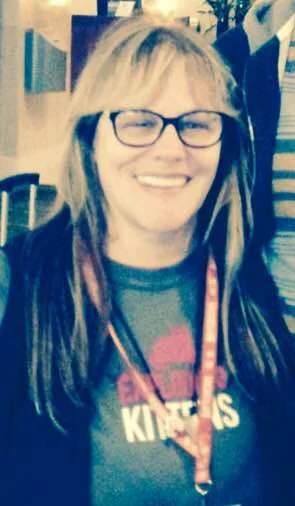
Between Ad Magic and Breaking Games, your businesses straddle the line between manufacturing and publishing. Tell us about how you reached that decision and how you approach those dual roles.
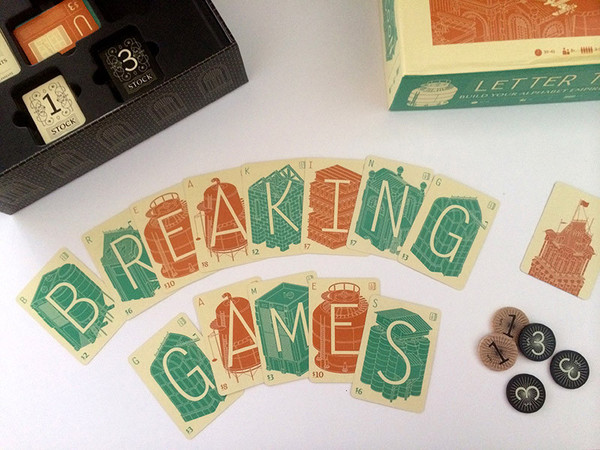
The only reason I started Breaking Games was because clients basically asked us to. Once I played the prototype of Letter Tycoon I knew I had to publish the game. Same thing with POOP, once people kept asking about the little game in the clever brown box over and over I knew I had to publish and promote the game. It was a natural extension of our business model--since we were already attending trade shows--to sell our clients’ games with them.
My dual roles are an interesting question. While I am the manufacturer for some very big games--which I handle personally--I also need to take the time to review and play the games of new designers with staff and oversee the agreements for how we will interact with each designer. Like the rest of my life in general, it is all about balance. I do my best to maintain it.
You've given designers working with Breaking Games booth space at conventions to promote their games, to a greater degree than most other publishers. How does promotion fit into your publishing model?
To me, the designers are rock stars and the games are their songs. The booth is simply the stage we set up for them to play on and demo their masterpieces. We get grassroots feedback and interest for the games, and this helps with the real-world job of educating people about and promoting the games.
Ad Magic focused on making promotional items before expanding into board and card games. How did this transition happen, and what have you learned about pivoting a business into a new line?
The transition happened when, for some unexpected reason, I fell in love with making playing cards and poker chips. Businesses are driven by what people are passionate about. Circles and rectangles were easy to design for, and I loved the simplicity. I came from a world of complex shapes and constantly changing print requirements for different mediums. Our jingle stated things like "from Toilet paper to the Taj Mahal, we can print your logo on it all, paper plastic vinyl leather brass and stone, and even magnetics, glass and rubber and foam, that means we can print your logo on anything..."
So I rebuilt the website to reflect custom playing cards, and suddenly we were number one in Google for "custom playing cards"! The website was awful, but the guys from Cards Against Humanity called and had us print their little Kickstarter :) and that started us down the Kickstarter manufacturing path, which led to card and board games.
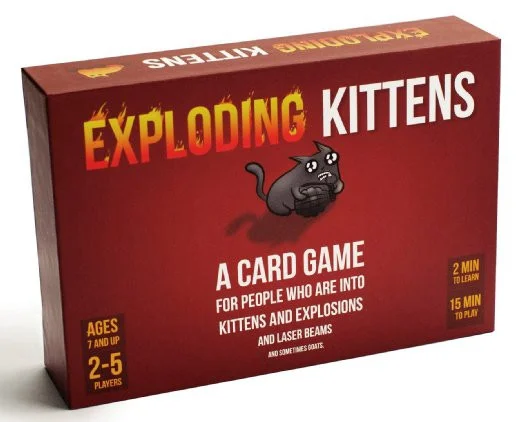
What I have learned about pivoting the business is that you never truly pivot all the way; you take your previous skills with you. And it’s a good thing too, what with making oatmeal packs with cards in them, popsicles and cereal packs with cards in them, bullshit in a box--all of these capabilities came from our background in promotional products. Ironically the items and games are WAY more complicated now. Besides the crazy CAH and Exploding Kittens things, the strategy games and Euro games we are making include all kinds of materials: custom wooden parts, mini and metal pieces and even electronic components. So the effort to make things simpler only went so far, and in the end we are making items that are more complex than ever! Just look at Moonquake Escape, Kings Abbey and Fujian Trader, to name a few!
What do you look for when partnering with designers? Do the requirements change depending on the type of arrangement you make?
I look for equal parts great game and great person. All of our arrangements are custom, just like our products. We are trying to standardize a few things, but for the most part all designers have different needs, and we try to accommodate them as best we can.
Some games are in different stages of development when they come to us. Some are ready to go, they just need a little assistance in bringing the game to cons. Some need a lot more assistance, full art development, rules need to be redeveloped, etc. That is what I mean by custom development.
As far as deals go, the deal is based on the mutual agreement between Breaking Games and the artist in direct relation to what each side brings to the table.
Cardboard Edison Omnibus is supported by our patrons on Patreon.
SENIOR INVENTORS: Steven Cole, John du Bois, Richard Durham, Matthew O’Malley, Isaias Vallejo
JUNIOR INVENTORS: Stephen B Davies, Luis Lara, Behrooz Shahriari, Aidan Short, Jay Treat
ASSOCIATES: Robert Booth, Doug Levandowski, Aaron Lim, Nathan Miller, Marcel Perro
APPRENTICES: Kevin Brusky, Kiva Fecteau, Scott Gottreu, Michael Gray, JR Honeycutt, Scott Martel Jr., Marcus Ross, Diane Sauer
A discussion of solo gaming and its place in the board game industry:
http://www.thecubistpodcast.com/podcast/2015/12/29/episode-9-there-can-be-only-one
Advice for new designers: sell to a publisher or publish it yourself?
http://www.cephalofair.com/2015/12/haphazard-advice-fledgling-game-designers.html
A discussion of manufacturing quality: defects, gauging quality, print on demand, and more:
http://theforbiddenlimb.libsyn.com/manufacturing-quality-ep-31
Pros and cons of worker placement:
Strategies for getting the word out about a game at a gaming convention:
https://sites.google.com/site/shootagaingames2/convention-schedule/convention-promotion-post-ks
“Generally you should have an idea for the moments you want your design to foster so you can work towards those when you fail.”
2016 One Page PNP Contest
Deadline: April 15, 2016
http://boardgamegeek.com/thread/1493133/2016-one-page-pnp-contest
“My tip for pitching to publishers is to simply be your game’s biggest fan. Be confident in your design when you pitch. Don’t waver or give any indication that it is anything but the best game out there.”
“Make sure you’re having fun. If you’re not enjoying the game you’re designing, and the development process that it takes, then it’s pretty difficult to expect others to buy into it. If it’s fun for you, keep at it. If not, perhaps try something else.”
David Short on designing within constraints, knowing your audience, balancing games, making prototypes, questions for playtesters, and more:
http://theinquisitivemeeple.com/2015/12/21/designing-meeples-with-david-short/
How to create content for an expandable game:
On the danger of rejecting others' ideas out of hand
[game mechanic]: The [game mechanic] Game Contest
For games in which the title and the core mechanic are the same
Deadline: Jan. 18, 2016
Prize: publication by Greater Than Games
https://greaterthangames.com/content/a-new-game-design-contest
“As game designers, it is vital not to perceive critical feedback as a personal slight against us or the games we create. Well-intentioned valid criticism can be the spark that drives us to not accept good enough and instead elevate our work to the next level.”
Bruno Cathala on the design process, taking playtest feedback, co-designing, expansions and more:
http://ninjavspirates.libsyn.com/s12e04-design-thoughts-from-across-an-ocean
Zev Shlasinger on founding and running a company, working with a publisher and more:
http://breakingintoboardgames.libsyn.com/breaking-into-board-games-episode-7
Lots of advice for writing rules: where to start, clarity and readability, game terms, examples, repetition, pronouns and more:
http://theinquisitivemeeple.com/2015/12/16/designing-meeples-talks-writing-rulebooks/
35th Concours International de Créateurs de Jeux de Société
Submissions: Jan. 4-29, 2016