








An interview with the designer of the newest best-selling game on The Game Crafter:
http://news.thegamecrafter.com/post/21901010552/we-decided-it-was-high-time-we-interview-the
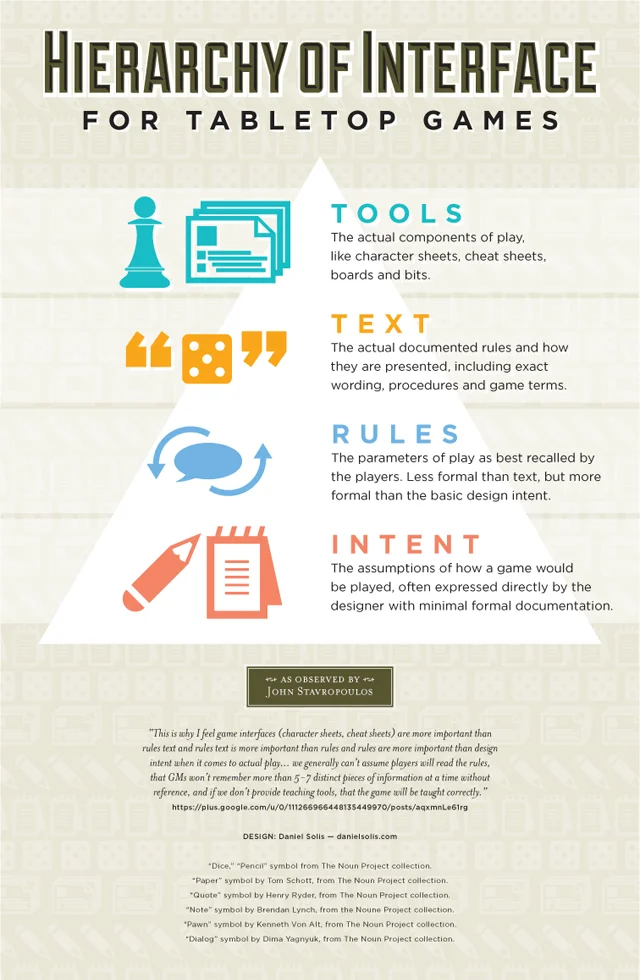
The rules hierarchy for tabletop games. Graphic by Daniel Solis.
“A @kickstarter campaign is like a business. Plan it like one” - Fred Hicks (@fredhicks)
https://plus.google.com/u/0/105843491826683668595/posts/jZ8QRJKVja5#105843491826683668595/posts/jZ8QRJKVja5
“There’s a tendency for people to think that a game is the sum of its mechanics. To me a good game is more than the sum of its parts. How those mechanics work with one another, and how they work with actual human players, makes a big difference in the outcome, and is much less than entirely predictable beforehand.”
How many ways are there to run an auction? More than you might think.
The Ludology podcast covered auction mechanics, in two parts (and in considerable depth):
http://ludology.libsyn.com/ludology-episode-28-going-going-gone
The “triangular theory of board game design” takes into account players’ emotional and sensory reactions in addition to theme and mechanics:
http://bgd.lariennalibrary.com/index.php?n=DesignArticle.Article200904210253PM
BoardGameGeek forum: What mechanic do you try to put in EVERY game?
It’s like a support group for board game designers.
http://boardgamegeek.com/thread/795409/what-is-the-mechanic-you-try-to-put-in-every-game
Game designer Phillip duBarry (@pdubarry) on why Biblically themed games don’t have to be terrible:
http://whyidesigngames.tumblr.com/post/21778833975/phillip-dubarry
Services like Kickstarter and Amazon are upending the board game industry and creating new economic opportunities for game creators.
For the 50th episode of his Funding the Dream podcast, Richard Bliss (@GameWhisperer) gives a passionate, prophetic overview of the emerging new order.
http://www.buzzsprout.com/4646/46862-funding-the-dream-on-kickstarter-ep-50-richard-bliss-speaks-out
Solo playtest a real-time game: impossible?
Not to the BoardGameGeek designer forum. Some ideas for how to do it:
http://boardgamegeek.com/thread/794602/how-to-solo-playtest-realtime-games
Game Salute answers some questions about its Springboard service for crowdfunded board game projects:
http://www.purplepawn.com/2012/04/game-salute-and-springboard-what-do-they-actually-do/
Puzzle Strike designer David Sirlin on asymmetry, tournament-quality design and player elimination:
http://boardgamegeek.com/blogpost/9606/designer-diary-puzzle-strike-the-quest-for-a-tourn
What’s the secret to creating a sustainable game publishing business?
Michael Mindes (@MichaelMindes) of Tasty Minstrel Games (@TastyMinstrel) reveals all!
http://www.purplepawn.com/2012/04/3-simple-steps-to-create-lasting-board-game-success/
A great list of the best BoardGameGeek forum threads and geeklists on board game design. Covers a lot of territory:
http://boardgamegeek.com/geeklist/140807/best-bgg-forum-threads-geeklists-on-board-game-de
Table Top Studio, a new program for boardgame creators, is in private beta. You can design components and integrate with The Game Crafter:
http://boardgamegeek.com/thread/793161/table-top-studio-a-new-application-for-game-desi http://tabletopgamestudio.com/
“The most important skill to designing games is understanding why games are fun. In designing a game, you are trying to entertain a player (this can of course be serious thinky fun, wacky fun, banana fun, depending on the player). When you can identify that bit, you’re well on the way. To do this, you must play many games, with many people. A terrible fate.”